Selek was expected to take Sekir’s place as Captain of the Temple Guard, a ceremonial term that would have been Head of Security in a less traditional setting. The Mother Superior was only too happy to have a talented warrior in the position. The circumstances had also freed her from the clutches of Matron T’Urel. but even without the connection of her son, as one of the Temple benefactors she still had some influence in the process.
The Matron had instead honored Selek by suggesting he take an assignment off-world to prove himself. The real intention was much more insidious. It was intended to separate the couple under the guise of a compliment, and it wasn’t lost on either of them.
Selek wasn’t sure he liked the idea of working on a starship, even if it was just temporary. Perhaps it was a hangover of adolescent rebellion against his mother, but he had no interest in pursuing a career in space.
It was only one trip, the briefing specified, and little more than a routine fetch quest, should everything go according to plan. The Kir’Shara of Surak had been discovered by Jonathan Archer[8], so it was fitting that Selek, the son of the Vulcan who had served as Archer’s Sub-Commander, would honor his mother by fulfilling a similar mission.
Selek was displeased with the nature of the mission itself, but the subject matter took hold of him. The collection dated from the Time of Awakening, and when Those Who Marched Beneath the Raptor’s Wings[9] had left the planet, they had taken these rare artifacts with them. They were to be retrieved, by force if necessary and returned to Vulcan where they belonged.
“It’s an important mission,” T’Nedara said, when she saw him standing at their window and pouting.
The upper floors of the Tinsha Monastery had formerly been where the acolytes stayed, but there were fewer adherents these days and the Dormitories were now downstairs, close to the Infirmaries. They were in disrepair, covered in dust, the curtains either gone or hanging in tatters, but this little corner had been a gift from the Mother Superior.
The young couple had fixed it up into a rustic but functional apartment, and the cool wind always blew in from the surrounding mountains.
“You said they were interesting pieces of history, and they must be returned.”
“I did,” he said, brightening a bit and turning to her as he spoke. “I’m honored to go, for my mother’s legacy and for the Temple.”
He hesitated for a moment.
“The timing is unfortunate,” he said, his voice was a mix of tenderness and frustration. “This is not a time for me to leave my mate, and even before her Mother Superior has eaten the sacred V’Shal.”
“You are forbidden to purchase even a single halak[10] on your humble salary,” the words were harsh but her voice was gentle, and she put her arms around him as she spoke. “And there is no need for it. I am an orphan, with no bloodline or ancestral name, and the highest authority of this temple will defer to the ancient rites.”
Selek was content with her answer, but in his own mind he resolved to have a word with the Mother Superior before his departure.
“Your wisdom honors me,” he said.
“Your courage is my strength,” she replied.
He withdrew from her embrace.
“There’s no safer place than the Temple for me,” she looked into his eyes as she spoke. “Is your concern one of Vulcan duty, or human sentiment?”
He looked back at her, and blinked slowly, considering the true meaning behind her question.
She leaned in closer.
“You don’t have to wear them now,” she said. “Why here, in our home?”
“A human would say, “force of habit.” He replied. “Perhaps I shall grow too comfortable, and walk out into the Central Dias with my father’s eyes.”
“Nobody here would judge you,” she said. “They know about your mother.”
“It seems to be the secret everyone knows,” Selek turned away from the window as she spoke and walked over to the sink and mirror.
T’Nedara looked out over the mountains and desert. The lights of Shi’Kahr, Vulcan’s biggest city, twinkled in the distance. A cold breeze, a remnant of the desert night, blew into the apartment. She shivered and turned to get her shawl, but Selek was already there, wrapping it around her shoulders.
She looked at his eyes, now free of the plastic covering that hid their exotic color, and they shone blue in the dim light.
There weren’t many who had seen Selek’s eyes without their lenses. The first time T’Nedara had seen them, they were standing on one of the balconies that lined the upper floors, in one of the quiet corners designated for their meetings.
He told her a story about his early days at school, when he had casually asked the other students what color eyes they had under their lenses. What followed was a change of schools and an increase in private tutors for a few years.
“Are they really so different?” She asked.
“There are those who would refer to them as a deformity,” he said. “It could be seen as a defect in a Vulcan. It’s a logical assumption.”
T’Nedara frowned.
“I don’t agree. It sounds like an illogical assumption to me. They seem to work well enough.”
“The lenses don’t affect my vision.” He explained. “I can see without them.”
“Their function is only cosmetic?”
“Yes. And I can wear them for days.”
She hesitated for a moment. He secretly dreaded what he knew she would say next.
“Can I see them?”
Selek took it for granted that his eyes were disturbing, even unsightly to Vulcans, but he didn’t want to tell her no. Some of his previous friends and lovers had been drawn to him because of the rumors about his ancestry, but very few of them had seen his eyes.
“I’ll show you one, so I can put it back quickly,” he said, thinking it was a decent compromise. He leaned closer to one of the glass panes that separated the inner balcony from outer one, and peered at his reflection for a moment before carefully pinching his right iris and lifting the lens away.
She caught her breath and for a moment his heart sank. Was she shocked and horrified, or surprised and fascinated?
T’Nedara leaned in, and looked at it carefully.
“I would almost expect to see through it,” she said. “It’s not the blue of a bird’s egg. It’s more like the color of ice or water.”
He hid a smile of relief as he bowed his head and slipped the lens back in.
“When humans say, “the eyes are the windows to the soul” it’s a philosophical expression, not a literal description.”
“I’m aware of that,” she raised an eyebrow.
“I think I was making a joke,” he raised his eyes, now both returned to their typical Vulcan obsidian.
What followed was a conversation about the human use of confusing metaphors until T’Nedara was called away to the late-night ritual, one of the many daily events that she was responsible for officiating.
The next few days included several briefings in preparation for his quest, along with his usual duties as the new Captain of the Guard. Selek was compelled to choose a small team of soldiers to accompany him, although the crew of the ship that would take them to their destination was provided by the Vulcan High Command.
The Mother Superior and his closest fellows in the guard helped him decide who was best suited for the trip based on medical records and experience in outer-space. It was after this briefing that Selek was able to approach the temple matron privately.
“Mother Superior,” he said, as his peers filed out of the room, “I would ask for a word.”
She took her seat on the raised seat on the ornate dais at the head of the plain stone table that stretched into the center of the room. Selek rose from his seat.
He stood before her and bowed his head.
“Speak, Selek.”
“I wish to extend my deepest gratitude,” he began, “for your…”
“Silence,” she interrupted him sharply, but politely. “You owe me nothing. I have done no more than protocol asks of me. It was my duty to oversee the Kal If Fe, and I have done so. The rite was yours to win or lose. You have a question, what is it?”
“I understand…that as a secondary consort, T’Nedara would have been permitted to stay in the temple, only to go to the home of her husband if summoned.”
The Mother Superior nodded.
“But…if a resident of the temple were to marry her, even as a principal wife…”
“Selek,” she interrupted him again, her tone softer, “you are a novice in the Temple ways. Know this. As a secondary wife, T’Nedara would have stayed in the temple. However, she would never have been permitted to ascend to the role of Mother Superior.
“The temple also has its politics,” she spoke more gently now, seeing the disappointment in his face. “You may live by her side as lover and consort, guard her person, father her children. But if she is married, rivals will claim she cannot have two loyalties. They are correct. It is a logical conclusion.”
There was a moment of silence in the chamber. Orange light flooded over the table as the sun dipped lower.
She rose to her feet, and Selek took a knee.
“It is I who should thank you,” and her voice grew strong again as she stepped towards him. “Only a few days ago, this temple was under the thumb of a petty tyrant. Your pain and sacrifice have freed us.”
He bowed his head, and she reached forward and gently touched the same pressure points on his face. There were still bruises and scratches where he had been wounded during the fight, and in only a few more days he would rise into the dark underworld of space.
“I can see your love for her is sincere,” she said quietly. “And that she is joyous in your presence.”
“I sensed her pain during the duel,” he spoke without raising his head. “She was helpless, watching me fight, seeing my blood run, and standing nearby doing nothing more than watching.”
“You saw her?”
“My state made hyper-aware of everything. I even remember the smell of the dust.”
“Every god has a mirror image,” the Mother Superior replied by quoting an ancient Vulcan proverb. “The time will come when she will be the one in a fight to the death, and it is you who will stand by helplessly. Should the fates be merciful, she will survive and triumph, as you did.”
Selek raised his head and looked at her with a raised eyebrow.
“It will be clear to you in time,” she said, and removed her hand. “But I sense there is one more thing you wish to say.”
“Yes,” he said, “After the duel, when they brought me to the infirmary, and T’Nedara revived me. I saw you, when you closed the curtains and herded the others away. There was that one you hit with your stick…”
“That’s enough,” Mother Superior spoke sharply to hide a snicker. “The mating rites are sacred, and not for public display. For what are we, Terrans?”
Now it was Selek’s turn to bow his head and stifle a quiet laugh. Of course, the Mother Superior probably knew his ancestral secret and she was teasing. He dared to think she might actually be fond of him.
“Your path is clear. Rise and go, Selek, Lord of the Lirpa, and Consort of the Intended Mother Superior.”
He wished her a pleasant evening and took his leave.
The sun dipped below the mountains and the inner chambers of the temple grew dark.
Selek was pleasantly surprised to find a communication from Koss waiting for him in his personal mailbox that same evening.
Selek;
I was pleased to hear your recent news and have recently been in contact with your mother. T’Pol also sends her regards, and she is currently on assignment off-planet but expects to return within a few solar days.
T’Ona[11] and I are currently attending to our eldest as he begins his first year at the Vulcan Science Academy, but I will visit the Monastery as soon as possible. Vorick and his brother also send greetings.
I am told the Mother Superior has an impressive library, and it would please me to see it.
May your journey be free of incident.
Koss
There were two places at the Monastery where a shuttlecraft could land or take off; either from the roof, and in a space at ground level outside. A brief ceremony was planned to send Selek and his team away outside of the doors on the ground level.
They met quietly in a dark alcove before the gong sounded. T’Nedara was in her white robe and veil, lined with simple black embroidery in the shape of Vulcan calligraphy. Selek wore the uniform of a soldier, but dressed for travel with a cape and traditional helmet.
Goodbyes had been said, but T’Nedara wanted one more thing.
“What you showed me when we saw the mover,” she whispered. “Do you remember?”
“The movie,” He corrected her gently. “Of course I do. I was bound to you in that moment.”
She lifted her veil, and he leaned forward to press his lips against hers. This exotic gesture was a human custom that would be unfamiliar to Vulcans for another hundred years.
He stood up, helped straighten her veil, and couldn’t hold back a smile. The early light of the sun was behind her, creating a soft ring of light above her head.
His lifted his hand and offered her two fingers, and she met them with her own, a conventional Vulcan gesture between lovers.
T’Nedara turned and strode into the breezy open space. The shuttle and two of its uniformed attendants waited at attention outside. The Mother Superior was already there, standing in front of them, and her intended successor bowed before her.
The six attendants that had followed her parted and turned, standing to the side, forming a column. T’Nedara turned back towards the dark alcove.
At this moment, Selek stepped out of the shadows towards the shuttlecraft, followed by his team of twelve soldiers. He led them and they walked behind him in two lines of six, their steps mathematically perfect as they walked to the raised platform.
The Mother Superior stepped forward. The bells rang, and they bowed low. The Mother Superior addressed him using his official designation as well as another title that she had personally given him after the Kal If Fe.
“Selek of the Lirpa, Captain of the Tinsha Temple Guard,” She said, “Your mission is one of great honor. To restore our culture and scripture is one of the greatest endeavors any Vulcan can undertake.
Your courage honors us.”
Selek raised his eyes as T’Nedara stepped forward. He raised his wrists, and she placed the ceremonial bracelets on them, etched with the traditional calligraphy that spelled out the temple blessings.
Her hands lingered for a moment. She raised her eyes.
“The words of Surak protect you,” she spoke gently, but her voice carried over the platform.
“Your wisdom is my strength,” He replied. “No challenge will bar my return.”
The last words he spoke to her were more personal than ceremonial. The gongs rang and the team filed into the shuttlecraft. Selek was the last to board.
The monks filed to the bottom of the raised platform and watched the ship rise into the air and soar upward. Their ceremony over, they walked back towards the temple.
T’Nedara remained alone on the raised platform. Her veil and robe shuddered in the wind but her body stood like a vestige carved in stone. She continued to look into the sky until the sun had fully risen and the bell for the morning prayers had sounded.
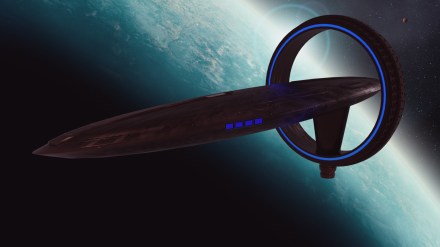
The shuttlecraft lifted towards orbit.
Now they were in the hands of the Vulcan High Command. The briefing regarding the mission began in earnest, and in more detail.
The artifact was a collection of writings dedicated to Surak. Not only dictated by him personally, but with extensive notes and commentary by his students and colleagues that was equally valuable.
The secret group of Surak worshippers hiding on Remus couldn’t keep the scriptures safe anymore. They had already been ciphered and hidden, in a form that was yet to be revealed, and “the Stone” was simply a nickname the artefact had been given for the time being.
A desperate message on a long-dead line in an obsolete code, which had arrived after months of delay, could tell no more.
These would have been outlawed by the Romulan government, in ancient times as well as the present. Any Romulan that helped to hide it would have been executed and the artifact itself would be destroyed if it was found.
The crew spent several days being debriefed on the finer details of the mysterious object in question. It was assumed they were in digital form, but the ancient records being in hard copy was a possibility that could not be ruled out.
Selek quietly sent two text messages to T’Nedara every day while they were in orbit. One in the morning, when he first rose from bed, and another at night as he returned to it. He knew it would have seemed excessive to anyone monitoring their communications, and certainly someone would have to be to ensure the mission’s secrecy, but he felt strangely defiant about it.
It’s not that Vulcans don’t have feelings as an inherent trait. Their history demonstrates they often have the strongest of feelings. They are trained to control their emotions, and this does overlap into suppression for untrained or weaker minds. Selek hid his lonely despair behind the mask his mother had taught him to wear, the same one that hid his strange and terrible eyes.
The time came for their ship to descend into the deeper reaches of space, and he wrote his final message to his mate. During the mission, there would be no communication, and messages from deep space took weeks to reach Vulcan anyway.
He stared at the blank screen for a few minutes. There was nothing he could say that was not already said. No instructions or practical advice, nothing but sentiment.
Selek’s thoughts turned to his mother. She would have returned to Vulcan by now. He wondered if it was too late to send her a message, then reconsidered when he thought of the mission’s secrecy. There was little he could tell her about it. For a long time, she resisted telling him anything about the Enterprise. Stories started to trickle out when he was a teenager.
Selek remembered when they spoke about his older sister, a child conceived and born through artificial means.[12]
“We called her Elizabeth,” T’Pol had said, her voice taking on an emotional tone. “Tripp was inconsolable when she passed.”
Selek stopped thinking and let his fingers speak through the monochrome screen.
He hid a smile as he sent the message on its way. He recalled that fateful night when they finally met, and hoped that she would understand his awkward attempt at humor.
His initial title was Guard Initiate, and he had only been on regular duty for a few weeks. The building still confused him somewhat, and from top to bottom it had gone through many changes over the centuries.
The kitchens were traditionally on the main floor, closer to the lava pools that ancient Vulcans used for heat and energy. It was old, almost a cave in form and shape, and likely first area on the list for modernization.
It had been a long day of learning about his new home and fulfilling his various duties. The hour was late, and he was looking forward to a quiet meal and a warm sleeping robe. But his night was just getting started.
The old wooden door to the kitchen was loose, and it surprised him when it swung open at his touch. What shocked him even more was the person standing on the other side of it.
Selek had seen T’Nedara before, but they had not spoken nor had they been introduced. She was standing in front of a burning stovetop element, topped with an oversized silver pot, and she turned to look at him when the door opened.
They made eye contact. Then the door swung shut and almost hit Selek in the face. When he opened it again, she was almost smiling at him. A human might have laughed.
“Good evening,” she said politely. “Mind the door, it’s been loose for a while now.”
He nodded gravely, trying to salvage his pride.
The first time Selek had noticed T’Nedara it was as part of the ritual procession that led the evening services. His eyes followed her all the way down the open stairs to the glossy stone floor. He rationalized that it was the simple but graceful clothing of the monks that drew his eye, and nothing more.
That night in the kitchen she was not dressed in her formal wear, but a frayed, frumpy smock that looked like a pillowcase with three holes in the top. It was as if the universe had put her in shabby attire as part of a conspiracy to prove him wrong.
He tried not to stare and was completely unsuccessful.
“Aren’t you Selek?” She asked, peering into the pot. Steam rose from whatever she was stirring.
“Yes,” His breath returned, and he was relieved to find he could speak. “You’re T’Nedara, the Intended Mother Superior. I am…”
His breath fell short again. He dragged it forward with some effort.
“I am most honored to meet you.”
“Yes, likewise.” She barely looked at him. “I wanted to thank you for the addition to the pantry,” she added, and nodded towards a lush plant in a clay vase near the stove.
Selek had brought it with him as a friendly donation to his new colleagues. It was a simple cutting at first, but it flourished in the humid air and the thick, heavy sunlight of its new desert home.
“I was thinking about adding it to the plomeek soup.” At this point she furrowed her brow and lifted a large, dripping chunk of brown root from the simmering broth.
Plomeek soup is more often made from the blossoms and dried seeds of the plant, although roots are edible if prepared correctly. This method of boiling a root to mush wasn’t completely incorrect, but would have taken hours to render into some kind of mashable paste resembling soup.
Selek cleared his throat to keep from laughing and put on his best serious face.
“Perhaps…I know an optimal preparation method.”
She handed him the long metal fork that had the plomeek on the end of it and looked on with interest. He sliced the root into perfectly even slices, perhaps showing off with the knife a bit, then picked up the cutting board and fork and strode confidently towards the lava pits. He slipped his shoes off and then stepped from the cool stone of the kitchen to the hot volcanic rock. Even at this distance, several meters away, the magma was radiating heat like its own gigantic stove.
Vulcans grow up in an environment of arid heat and molten earth, and many of Selek’s trials as a soldier involved both.
T’Nedara raised her eyebrows but didn’t speak as he stepped over the hot sand and crouched by one of the rocks. He laid the reddish-brown slices out in a row, and they sizzled, exuding plumes of aromatic steam.
She watched in fascination.
“The smell is very pleasant,” she said, barely hiding her surprise. Plomeek was often boiled into soup that was nearly odorless and tasteless.
“In my opinion, this is a superior way to prepare plomeek,” he said. “However, I have never actually tried using hot stones myself.”
“Where did you get the idea?”
“I remember the ancient Proto-Vulcan glyphs that joined the living with the light and heat of the lava pits during my military trials in Gol. They were used for cooking, the historians said, and I resolved to try it someday.”
They only needed a minute on each side to toast up nicely on the burning rocks. Selek started to gather them back on the cutting board.
“I am very impressed. How fortunate that you would meet me here tonight.”
The sound of her voice washed over him like cool water. He followed it back to its source, carrying the grilled plomeek like a sacred offering.
“I am more than honored to serve the ranking monk,” he made eye contact with her as he spoke, but only for a second, all that his thudding heart could bear for the moment. He could hear her voice through his stinging vision.
“Please call me T’Nedara, and join me for a late supper.”
They talked into the night, nestled in the warm darkness of an active volcano. She told him everything she knew about the monastery, including its long history. He spoke of life as a teacher and trainer in Gol, but said little of being the son of sub-Commander T’Pol other than how he intended to move out of her shadow with a distinct career path.
The lush green plant was called basil, he explained, and eventually it would have long, white flowers. It was of Terran origin, a keepsake from the Enterprise, but he wasn’t sure where she had acquired it.
Late supper became an early breakfast. They prepared to take their leave.
“I’m sure we’ll meet again,” she said, “but until then, do you have any other questions?”
“I do, and I understand if it’s too personal. I noticed you are not wearing the usual temple attire.”
“It’s a vegetable sack,” she replied, without missing a beat, not ruffled in the slightest. “The plant fibers used to weave them are actually very comfortable.”
“How brilliantly efficient,” he commented.
“I am honored,” she answered, and bowed her head to hide a smile.
He let her leave first, so she couldn’t see him stride awkwardly back to his quarters. It wasn’t quite a limp, but anyone would notice that he had injured the bottom of his feet somehow.
T’Nedara
This is the last note I can send for you in some time. I recall our first meeting in the kitchen, and I still see you there, standing before the fire. My logic fails when faced with The Engulfment.[13] I will take this memory with me into the stars.
I have never seen a more beautiful sack of vegetables. Please be well.
Selek
[8] Star Trek: Enterprise, “The Forge”, “Awakening”, “Kir’Shara.”
[9] The Vulcans who rejected the teachings of Surak and left their home planet to evolve into Romulans.
[10] The main ingredient in V’Shal dinner, a meal traditionally served by a Vulcan male to his intended in-laws.
[11] Koss’ second wife.
[12] Star Trek: Enterprise, S4E21, “Terra Prime.”
[13] Known as “shon-ha-lock” in the Vulcan tongue, what humans might call “love at first sight.”




 Cristina in Oaxaca