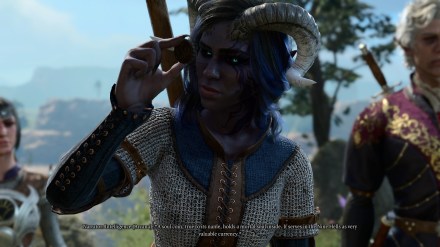
A Cleric of Talos

A Baldur’s Gate 3 Fanfic

Copyright notice: This is a work of independent fan fiction and is in no way affiliated with or used by the Wizards of the Coast.

“Most of these people are of no concern to ourselves but a Brasi is a powerful weapon to be used. The trick is that since he does not fear death and indeed looks for it, then the trick is to make yourself the only person in the world that he truly desires not to kill him. He has only that one fear, not of death, but that you may be the one to kill him. He is yours then.”

Mario Puzo, The Godfather

Character Creation

My father was a Cleric of Talos. His father before him was a Cleric of Talos, and his father before him, and his father before him.

It’s my grandfather, his father before him, that started this. I’m not talking about the tadpoles.[1] I mean the grisly fate of my own family; a long line of Clerics dedicated the chaotic powers of the storm.

Old Kozah,[2] as the neighbors called Grandpa, and I don’t know if this was a nickname or the real thing, was a professional when it came to calling attention to a massacre.

Grandpa used to call me Sparky because of the lightening in my fingers, or Frosty because of my white horns. My real name is Hypatia.

People in town had another name for Grandpa. They called him the Butcher of Baldur’s Gate, and he wasn’t just a murderer. He killed in the honor of the Storm Lord, and honored his god with regular offerings of sentient beings, as a Cleric of Talos is so compelled. Even his own family was terrified of his mood swings and scarred face. His eyes had long been burned white by decades of throwing blue lightning, and it was only by the grace of Talos that he could see at all.

We were powerful among the mobsters and thugs. Shameless goons you hire when you want the body eviscerated, burned, or blown up. It’s a crude way to send a message, and that’s the point.

Grandpa’s Domain[3] was Tempest, and he sneered at his son’s choice of the War domain.  He was more than pleased when my talents also emerged as Tempest.

“I thought you wanted me to be Death,” I said to him once, while we were gathered around the hearth after dinner. Grandpa dabbled in Necromancy when he wasn’t cursing his sons’ names and roaming the open hills with his dogs.

“Almost anything is better than War,” he gruffly declared, loud enough for Papa to hear. It was an evil thing to say, especially since everyone knew that Trickster was really the worst Cleric Domain, but no self-respecting follower of Talos would adopt such a discipline. Dad had some decent armor and weapon skills, and we always needed someone that could wear heavy armor, but no way was I going to contradict Grandpa.

I quietly admit, Druid has some deadly area-of-effect abilities. The old brute is dead now, and he can’t kill me for thinking about it. Ice Storm makes everything sharper and more smashable. If I study like a fiend, I can learn it at an advanced level as Tempest.

It took me years to figure out that Grandpa didn’t like any of his sons, but Papa in particular seemed to be his least favorite. Papa wasn’t a Tiefling, but that was the first in a series of many disappointments. My parents got a moment of redemption from Grandpa when I was born, a blue-skinned Tiefling with glowing eyes and curved horns.

Historically, our family had been a mix of humans and Tieflings[4], but Papa’s generation was entirely human, and my father had married a human. Perhaps the upheaval of the Hells and the sinking of Elturel also had something to do with it.[5]

He heard the whispers. In the dark alcoves of the Temple. The voice of his god or the ravings of his own personal madness. His children would purge the hell-spawn from their bloodline. That meant him, too, and the two of us were the last Tieflings left in the family. I nodded, but also wondered if decades of Necromantic magic were nibbling at his brain. I spent so much time with Grandpa in the Keep in the countryside that I didn’t see much of my parents or their home in Rivington.

Maybe that’s why I wasn’t exactly heartbroken when Grandpa killed every last one of them.    

 He set the charges days in advance and ignited them during an annual family gathering. My uncle, his wife, their grown kids and some smaller grandkids, my parents, and my human baby brother, and probably a few of the keep servants.

It was the ultimate offering to Talos. He wiped the whole family.

Well. Almost.

I knew about the charges. He didn’t tell me. I saw the trails of powder and followed them to the kegs, stacked in the pantries and closets like so much storage.

So even if Grandpa hadn’t given me a full rucksack, and told me to start walking that way I was planning on leaving anyway.

Leaving without telling anyone. Knowing they would all die, and doing nothing to stop it. Power comes to those who embrace the will of Talos.

I told my grandfather this as we stood there in the little back courtyard with Phobos and Deimos sniffing around our feet. Blurted it like a confession, but kept my voice low, and no crying, that’s for damn sure.

He was not angry. In fact, he was happy. Almost burst with pride knowing that I would accept his will. It was a bit scary. Maybe it’s because he was at peace, knowing he would also be blown into burning dust by the time I left.

He helped me put the rucksack on.

“Follow the dogs when you reach the end of the road. They know the way. They were born there. Turn your Tempest to the service of our god.”

“Talos will be pleased with such an offering.” I spoke proudly, understanding only the will of my ancestor and the will of the cruel and mysterious Storm Lord.

He put a finger to his lips, and I realized I might have spoken too loudly. He then returned to his usual authoritative self and gestured towards the door.

A sudden terror reached down my throat and stopped my heart. For a moment it seemed like my feet were stuck to the stone tiles. I was standing on the edge of the storm, waiting for the lightening to break the sky in half.

The movement of the dogs as they leaped to their master’s command broke the spell, and I ran after them as they charged through the archway that led from the courtyard and into the fading daylight.

The exit led to the back road, almost overgrown with vines and tall grass. Darkness was falling quickly and I wondered if should risk a Daylight spell, just for a while, until I knew where I was going.

I know what made me stop when I got to a vantage point on the hill. I should have kept going, but on the other hand, a part of me wanted to see it.

Domains aren’t exactly chosen; some Clerics have talents that others don’t, while others have certain natural talents or quirks of character that point to the more or less obvious.

I always had an aptitude for lighting and ice. No doubt about it. My baby blanket used to glitter with frost. If you held little me in your arms, your hairs would burn with static electricity and stand on end. But more than that, and I think what’s more important, is how much I like to blow stuff up.

Thunder is such a great power. Thunder is everything the Storm Lord loves the most and a few things more. It silences enemies and shatters eardrums, but it also turns bone and rock to dust. An offering of chaos and pain to honor the Destroyer.

Electrical damage is a close second. The buzzing fire burns foes to a crisp, while giving the target plenty of time to scream for mercy, writhing in agony, as it pleases the Raging One.

Fire is great, but the best fires are the ones that start with a streak of blue lightening or a yellow spark. A part of me wanted to stay behind and help Grandpa light that thing.

So, I looked back at just the right moment to see it happen.

I could hear it first, a long and uneven sputter, a fuse lit and burning fast. Then a split second of silence. I blinked, and the charges started to explode.

No matter what the Domain, any Cleric of Talos would choose the power of chaos when committing mass murder. Or, any kind of murder. It couldn’t be something covert, like poisoned soup or a cloud of poison gas. It had to be big, shocking, horrific, and most importantly – public.

The family’s keep was in a hill overlooking the River Chionthar, a few leagues east of Baldur’s Gate. The fire lit up the night, turned the river a liquid gold, and several repeated blasts made sure everyone was awake to see it. I think it was the third that knocked me down, and I remember feeling debris falling over and near me. Mostly from the wood and tile roof. Some of it was on fire, and most of it was smoking. 

My ears were ringing and I was having trouble breathing. The impact had knocked the wind out of me and all I could think about was catching my breath. So, when I heard voices, my first thought was to roll into the bushes next to the road and hide from whoever was there.

“Wow, good thing we weren’t in the Feast Hall for THAT! Seems to have missed the barn, though.”

“Shhh, someone will hear you.”

I managed to sit up, and the bushes caught in my horns. The ringing faded, leaves drifted into my lap, and all I saw were the two dogs.

“Oh, she seems to be alright!” Phobos said. “Good! We have to get her to the Master.”

They were talking.

Talking animals isn’t weird thing in Faerun. There are spells you can cast or potions to take that allow this effect. However, I had done neither of these things.

Phobos was the smart one, a black Labrador. I asked him about it.

“Why can I understand what you’re saying? Did Grandpa cast a spell on me?”

Some Clerics knew how to cast Speak With Animals. I had no idea if Talos had granted this power to the old man.

“Oh! Well, isn’t that neat! Deimos, she can talk to us without a potion or spell.”

“Might have been the blast, tweaked her ears and spellcasting,” Deimos was a chunky pit-bull and looked at me happily. “Hello, Child of the Pack! Feel better and follow us, okay?”

“Good boy, Deimos,” and my shaking hand was steadied by his warm tongue.

“The Chief of your pack has told us to bring you to Master.” Phobos started to walk slowly up the hill as he spoke. “There are other humans coming to the Keep. I can hear them. The City Guard, but also the looters, the rival dogs, those who would rob your Pack Leader in death and slay the lone survivor.”

“We know the way,” Deimos hopped ahead, almost joyfully, but trying to stay covert.

Everyone would know that the Butcher of Baldur’s Gate, and his whole family, had been killed in the blast. I could live safely for a while on the road, and if they ever discovered that I was still alive, I would be lost in the wilderness instead of a threat to them.

It was 1482 DR, I was 15 years old,[6] and the remains of the Keep crackled merrily behind us.

We stayed off the road and headed north across the Fields of the Dead, turning west to Roaringshore, then north along the coast to Lathtarl’s Lantern. We’d take a ferry from here to the western islands, but first we could rest and resupply at a friendly location.

For a Talos worshipper, friendship is not easy to find.

Just north of town was the Grotto of the Queen, a temple dedicated to Umberlee. Also known as the Bitch Queen, she was a consort of Talos in our mythology, and their worshippers were considered family, bound by faith if not by blood.

I was there for three days, long enough for them to give me a sordid nickname; the Butcher’s Child. But that’s a story for another campfire.

From the beginning, I never asked the dogs where we were going or why because I didn’t expect them to know. They were born and bred on the islands but they wouldn’t know the names or places as I did. I knew we were going to Oman’s Isle because that’s where the dogs were from, but they wouldn’t have called it that.

Grandpa used to say that he would send me there too one day, but he never told me what I should expect to find. I knew better than to question his will. My calling as a Cleric was to sow chaos for Talos and beg for his capricious mercy, not to ask the lord of my house stupid questions.

The ferry that took passengers west wasn’t just for people. Cattle, pets, and draft animals also crowded the deck, so there was nothing unusual about my two dogs. Grandpa had even included the fare in my meagre travel budget.

A giant turtle pulled the slow, but steady barge across the water, driven by a gruff old woman with a curved pipe and squinty eye. I saw a twitch in her weathered expression when she saw me. Her one good eye rolled towards the dogs. The smoke from the pipe floated along behind it.

“You going to Oman’s Isle?” She fixed her gaze ahead as she spoke.

There were four stops on this route, and I knew Oman’s Island was not one of them. It was an interior island, a craggy mountain peak sticking out of a deep, foreboding bay surrounded by icy mountains.

“We’ll be getting off at Kingsbay,” I said, answering a different question and putting a sharp edge to my voice. “Why did you you mention Oman’s Isle?”

“He always came for the black dogs,” she said, an electric twinkle in her eye. “The ones the giants would breed.”

She nodded towards Phobos and Deimos. A wisp of smoke came out of her mouth.

“There are a few small towns along the coast,” she wheezed, gently pulling the thick reins. “Codscove has a ferry to the Iron Keep, if you want to know.”

“I do,” I said. “May the Storm Lord have mercy on you.”

The Master had some kind of reputation, connected to the dogs, to my grandfather, all forever bound to Talos.

The driver grunted, nodded, and prodded the turtle through the current. I turned back to the dogs.

The three of us huddled together on the deck. The tales of our passage, and of the days we spent following the river north to Codscove, would make for a whole other story. It was only because of my powers to bless and protect that our hired boat made it across the mines and monsters to safely reach the shore.

It was the perfect location to hide from the incident in Lathtarl’s Lantern. The town lay in ruins during this time, the population long since driven out by the giants and their minions, but a smoking chimney at the northern end of town indicated at least someone was left. The cold wind whipped over the crusty snow, and I tightened my wool cloak around my shoulders and started to trudge towards the ruined city.

The dogs were excited, and wouldn’t shut up about all the familiar smells. Frozen goblin blood, dead fish, old rope rotting in the broken boats by the shore.

“We’re not going to the Keep?” Deimos asked, scampering up to me and rubbing against my thigh.

“The mountain path that wound up the dark side of the mountain would be cold already,” Phobos answered for me, “and maybe the front gate of the Keep isn’t open at night.”

Our little adventuring party neared the source of the smoke. A wisp of think smoke rose from a shabby, bent chimney that leaned on a precarious angle. The walls of the hut below it were of granite and mud, holding together well enough, framing a cracked wooden door. It looked like it had broken in half and been put together with some wooden slabs and metal pegs.

The little house was quiet, but light flickered between the gaps in the broken door. I could smell burning charcoal and baked potato.

“You two be good,” I said, and I drew out my begging bowl and prayer beads, “and I’ll get us a bed for the night.”

“And food?” Deimos said hopefully. The last day of travel we had all seen very little, other than the scraps Grandpa had packed in my bag.

“I’ll try buddy,” I gave him a quick rub on this head and stepped closer to the door. I slipped the prayer beads over my head and took off one of my fuzzy mittens so make playing the bowl easier. There was a heavy pendant at the end of the beads that I used for that. I ran it along the metal edge, and a single, sad note rose above the falling snow.  My chant was the usual humble monotone, designed to appeal to the listener as opposed to disturbing them.

Just a poor Cleric,

with dust on their feet,

looking for a bite to eat and a barn in which to sleep…

Show your faith,

to your faith be true,

and may the great lord of storms have mercy on you.

Something shuffled inside, and the door opened with a creak. A strip of warm yellow light poured out into the dark blue shadows of drifting snow. The resident seemed to be a scarred, grizzled old man, bent at the back, and missing an eye.

“Greetings, Cleric,” He smiled, all gums and beard. “May chaos follow in his footsteps. Come, warm yourself by the fire.”

He meant all of us, of course, and the dogs followed me quietly. Their obedience was rewarded almost immediately when the old man reached down to the hot rocks by the fire and picked up two massive stewing bones. They even have a bit of meat left on them. He whistled gently, and the two dogs sit obediently at his feet. I’m impressed with how well he handles them. He gestures towards the stool on the other side of the fire.

“Rest your cold feet,” he didn’t look at me as he spoke, but fed more heavy logs into the fire. “This should go all night, keep you all warm.”

It crossed my mind that he didn’t say, “keep us all warm.” But I was distracted by what he said next.

“Going to the throne, I suppose?” He handed me a steaming potato and a lump of crunchy bread. Then lowered his voice and said, “’ave an audience with the queen, do yer?”

If he eked out some kind of living here, perhaps fishing or mining, then he would have known about the throne and made some kind of peace with the current residents. The giants lived in the Iron Throne during this era, and their leader was the notorious Queen Connomae.[7] This was the one the dogs called Master. Her mind and body had been warped since birth by the Fomorian curse, and her mind was twisted by years of wielding deadly arcane power. I knew this much from my History lessons.

“I wasn’t sure what my grandfather had in mind when he sent me here,” I said, while trying to balance the hot potato between my fingers and face using the bread. “I hadn’t questioned it. Such is not my place.”

The old man stoked the fire. He turned to me and seemed to change. That one eye glowed a lightning blue, and wind filled the cabin.

The fire winked out like a candle. The dogs froze mid-bite, their black coats deep blue with ice. My throat closed, locked with a mouthful of frozen potato.

“You and your grandfather will be rewarded for your obedience. Old Kozen’s blood sacrifice is my nectar. The Queen will also be your master, and school you in the art of Talos and his worship. Focused on the art of death, by the bludgeon or the blast. Wrath of lightning, wrath of thunder.”

I’m a Cleric. I know what the face of my god looks like.

“Wrath of lightning, wrath of thunder, praise Talos,” I wasn’t speaking, but I heard my voice.

His face seemed to grow smaller and somehow younger. Someone I recognized but hadn’t yet encountered. “Do not forget the cold embrace of Umberlee. Swift, savage, and quiet. So quiet.”

Wait, what?

As if a spell had been broken, or perhaps I was dreaming, I blinked and found myself sitting by the fire with the dogs. Phobos and Deimos were merrily chewing, oblivious to the scene I had just witnessed.

“Where did he go?” This was more to alert the dogs to his absence. They were indulging in those big meat bones and hadn’t noticed.

“Holy cat shit,” Deimos jumped up and spun around, ears flat, hackles raised.

 The old man was gone.


[1] A reference to the main plotline of Baldur’s Gate 3 (BG3)

[2] This is also one of Talos’ nicknames.

[3] Each Cleric in D&D choses a Domain, or a subclass. There are 7 in BG3 and 14 in D&D. A Cleric can choose any Domain regardless of their deity, but Talos prefers Domains that focus on chaos and destruction. Tempest is his favorite.

[4] In Faerun, Tieflings can be randomly born to a human and vice-versa.

[5] Wizards RPG Team. Dungeons and Dragons Baldur’s Gate: Descent into Avernus (D&D Adventure). National Geographic Books, 2019.

[6] DR is Dale Reckoning, a calendar used in D&D.
[7] https://forgottenrealms.fandom.com/wiki/Connomae

The Apis

The Vulcans were pleasantly surprised to find that they were not lost to the endless void of space, with Captain T’Erev being especially profound in her gratitude. She was also relieved to discover that one missing crew-member was alive, although not so well, and was recovering in sick bay.

“You’re welcome to see him yourself,” Ah’zhen suggested. “I was thinking of checking on him. Maybe you can help us with something.”

T’Erev raised an eyebrow but didn’t ask any questions until they reached Selek’s bedside. He was unconscious, and lines of warm blue light shone over his shoulders and arms. Virtual needles had closed the most serious cuts, while others were cauterized with precision lasers, and now the computer monitored his breathing and heartbeat. His right hand was the only thing out of order. It was gripping the hilt of a sword, and the long, narrow blade was also covering part of his chest and torso.

“We have an awkward problem,” Ah’zhen turned to the doctor to let her explain.

“His nervous system is uninjured,” the Doctor said, referring to a screen above the bed. “We don’t understand why he won’t let go of it.”

T’Erev studied the charts for a moment.

“Hm,” she leaned forward and regarded the unconscious soldier. Then she spoke, and the force in her voice startled the nearby Xyrillians.

“Major Selek, open your hand and relinquish your weapon. That’s an order.” 

Selek’s eyelids fluttered, and his fingers loosened their vice-like grip on the hilt of his sword. Two orderlies were nearby to snatch it up quickly, while the doctor and her assistant tended to Selek’s right arm.

“He saved the ship, and maybe all of us.” Ah’zhen said, as they stepped back to let the medics work. “17 Klingons, and that’s just the kill count. It doesn’t include injuries.”

“I expect a full debriefing on the incident,” T’Erev spoke as they left sick bay, “but first I have to see to the well-being of my crew.”

“Certainly,” Ah’zhen said, “Please join me for dinner, we’ll discuss the mission at length, as well as how to make room on the Apis for two starship crews.”

“Three, if you count the Major and his team,” T’Erev pointed out. “My ship and crew were but a means to an end. They carry the crucial information about the relic itself.”

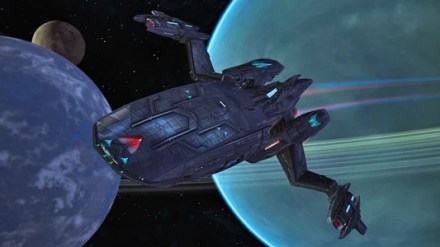
Ah’zhen led T’Erev into her Situation Room. The walls shifted from light green to dark blue. Ah’zhen swept her hand past a section of the wall and it turned into a viewscreen that showed how the Xyrillian ship had been bound to the Klingon one.

What followed was a briefing similar to what Selek had seen, but without the simulation. Ah’zhen explained the mechanics of the ship, how most of it was organic in nature and structure, the Targs, and how Selek had driven the invaders back singlehandedly and saved the ship.

“Fascinating,” T’Erev was referring to both the design of the ship and the story of Selek and Ah’zhen’s common ancestry. ‘But two questions remain. Why the galactic interest in an old Vulcan artefact, and why would Selek have taken such a risk?

The captains made a mutual agreement to discuss both issues when Selek regained consciousness. In the meantime, they discussed the logistics of fitting two starship crews into the relatively small space of the Xyrillians, and what steamed vegetables were available for their evening meal.

*

Selek was in a deep sleep for almost two days. He dreamed of deserts, grilled plomeek, and starships, and as he returned to consciousness, his mind turned to memories.

That school day was normal, but dinner was an adventure. He was about ten years old, and he usually took the shuttlecraft home with the other students, but today his mother was waiting for him.

She came to get him in a private shuttlecraft, one that she was piloting herself. It was just the two of them on the way home. He waited patiently for an explanation.

“We’re having a guest for dinner,” She finally explained, “an old colleague of mine from the Enterprise.”

Selek was secretly hoping for Captain Archer.

“His name is Charles Tucker,” was her voice actually cheerful, even…excited? “He was the ship’s Chief Engineer. He already met you once, but you were just a baby.”

Selek had heard of Charles Tucker. He was often in the history books right next to Archer, so it was still an exciting prospect.

“The history books say he was deceased,” Selek said, “I read he was killed in an accident.”

“It was a serious incident, and he was thought deceased at first,” T’Pol spoke as she maneuvered the shuttlecraft into the discreet landing pad behind their home. She continued as an answer to her son’s doubtful look, “not all of the history texts have been corrected.”

Selek raised an eyebrow in her direction.

“I’ve told you, space is unpredictable and often illogical. We’ll be dining here. Tripp…uhm…Mr. Tucker has insisted on preparing a meal for us.”

“Something Terran?” Selek was distracted from the puzzle of Tucker’s survival by the prospect of exotic food.

“Yes, that would be a logical choice.” As they approached the home, she gave him a few more instructions.

“It’s not necessary to be formal,” T’pol said. “Humans prefer more casual dress. You can also remove your lenses.”

Selek blinked in surprise.

“There’s nothing unusual about blue eyes on Earth,” she added. “Come into the main room when you’re ready.”

It was difficult for Selek to contain his excitement as he slipped out of his school uniform and into a casual bodysuit. It was a strange and alarming moment when he picked the lenses out of his eyes. He was accustomed to keeping this secret and removing them only before bedtime had become a safe, reliable habit. Walking into the common room, without his school uniform or dark lenses, his vulnerability was overwhelmed.

Two figures were standing there by the lounge chairs and center table, and they were speaking in hushed, excited tones. His mother turned towards him, and he would always remember the smile on her face. She had never looked happier or more beautiful.

“Selek,” she said, her voice strangely breathless, perhaps because she was speaking the Terran vernacular, “This is Charles Tucker, the Chief Engineer of the Enterprise.”

Charles Tucker regarded the Vulcan child for a long moment. Then he extended his hand, as Terrans do.

“Call me Tripp,” he smiled broadly, and Selek felt his own smile break through as he reached forward. He took a queue from the adults in the room and spoke in English.

“Hello, Tripp.” 

The chat over dinner was energetic, even cheerful. Tripp had made something called jambalaya. It was colorful and hot, just as Selek had imagined a dish from Earth would be like. Tripp explained that original recipes had included aquatic animals, but this dish had been modified to accommodate a vegan diet.

“The secret is really in the peppers and spices anyway,” Trip explained, “This is Creole as opposed to Cajun, with the tomato base. I made the extra-spicy version. Do you like it?”

“I certainly do,” and Selek was telling the truth. He was especially fond of the long grain rice, which had a pleasant, chewy texture. Rice wasn’t common on Vulcan, given that it took so much water to produce. “What kind of peppers did you use?”

This led to an animated discussion about something called the Scoville scale, which Terrans used to measure the heat of these delectable plants. The main one used in this dish was called the habanero, but Trip had also included ghost peppers and jalapenos, a wide range to impress a Vulcan palate.

“It’s delicious,” Selek declared, and proceeded to ask about culinary traditions in the American south. The discussion turned to literature as they tidied up, and Trip mentioned a book called The Yearling, “if you want to read a book about Florida.”

They sat in the garden for a while, and with the stars wheeling overhead, they contemplated space. Tripp talked about a place called Cape Canaveral. “They call that part of Florida the Space Coast. You should come and see it someday, Selek.”

And Selek thought, what a fantastic idea. It was the best dinner ever, and the last thing he remembered was falling asleep between Trip and his mother on the garden bench.

Good night, son.

*

He felt someone squeeze his shoulder. Selek opened his eyes.

“Welcome back,” It was Ah’zhen, the real one this time, wearing the same uniform as in the simulation. “How do you feel?”

Selek sat up and tested his limbs. Other than being sore, and covered in various cuts and bruises, he felt sound.

His memories came rushing back to him. A dream about the Enterprise. A sword, a sister, a pig? What was that smell?

From his sitting position in the infirmary bed, Selek saw a movement beneath him, and recognized the Targ from the garden.

“It’s been lying under the cot since we took you to sick bay,” Ah’zhen explained, “And of course, there’s no moving him.”

The Targ was a juvenile, but still big enough to choose a spot and keep it. He was staring up at Selek with big, dewy eyes.

“Your wounds are healing well,’ Ah’zhen said, “Can you stand up?”

Two orderlies helped him stand at his full height. The Targ regarded him with fascination.

“Where did you find me?” Selek asked, speaking to Ah’Zhen but staring at the Targ.

“In the garden, thanks to this brave fellow,” Ah’zhen nodded towards the pig. “If not for him, we might not have reached you in time.”

“But Selek, why did you go alone? We’re expected to debrief your captain soon enough. Can you explain yourself?”

Selek hesitated for a moment before launching into his usual Vulcan spiel about duty and taking the responsibility in order to expose his crewmates to less danger…

“That’s enough,” Ah’zhen spoke sharply. The orderlies cringed. “Stop making excuses. What did you see that would make you want to throw your life away?”

Ah’zhen was angry, but she didn’t want to admit that she had also been scared. What would have made a Vulcan do such a thing?

Then she remembered that Selek was half-human and caught her breath. He’d been looking at the media feed.

“Did you see something about Vulcan?”

He slowly blinked, and she knew she was on to something.

“I saw a report about a place on Vulcan. I place I know, the Tinsha Monastery. It’s been destroyed, along with…several of the residents.”

When he said the last part, his voice seemed to tighten and narrow. The captain acted immediately.

“Computer,” she said curtly, “Give me any recent reports about the Tinsha Monastery on Vulcan.”

The computer responded immediately.

“Tinsha Monastery. Location, Vulcan. Four solar days ago, the Tinsha Monastery was badly damaged during what is currently being called a terrorist attack. The Cult of Maripol has claimed responsibility. The Mother Superior was fatally wounded and most of the casualties were on the upper floors. The damage is extensive and the missing are presumed dead.”

“I want a full manifest,” she snapped. Selek’s cheeks had turned grey. “A full list of the dead, missing, and survivors.”

“The Vulcan High Command is keeping the details confidential. The identity of the…”

“You were sent by the Monastery,” she said. “You…you must have someone there.”

Selek remained silent.

“We have a debriefing with the crew this afternoon,” she said quietly but firmly, “at 0200 hours. Can I expect your attendance?”

Selek knew she was being facetious. It was not a request.

Chapter 5 – Mossy, Targ of the Universe

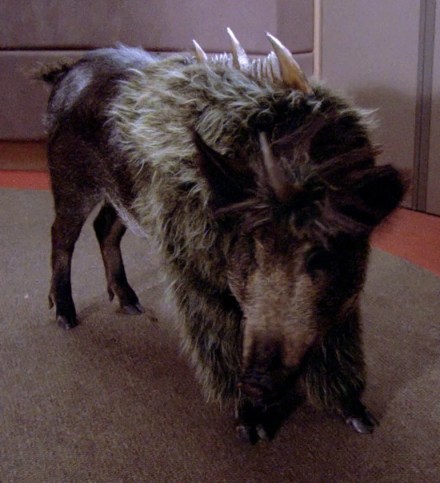
His mother had named him Mozinarah Orionoth Clefthoof of the Green Expanse, and his siblings, of which there were many, referred to him Mossy for short. His mother was a Great Matron of the Targ[1] Tribe, and had given birth to many generations of Targ in her lifetime.

They were not unhappy with the Klingons. Long had their tribe served as their pets and companions, but the garden of the Xyrillian ship[2] was too tempting to ignore. It had soil instead of gravel and living plants instead of straw, and after visiting nobody wanted to leave. Even after the flaps closed, plunging the plants and soil into darkness, it was still preferable to the freeze-dried kibble they had grown used to in space. His great uncle, a Targ of great wit and guile, had charmed the Xyrillian computer into allowing them access to the garden space. In return, they were to work with the bees and other plants and insects, to cultivate and consume their own share, in exchange for assisting their new hosts.

However, the migration of the Targs had aroused the Klingons to the presence of the hidden ship[3], and they had come in as far as the garden. Mossy was unsure of what he could do, if he should do anything, and decided to ask the one person he always turned to for advice.

Esmerelda Mozinorionoth Bristleback Clefthoof was an older Targ of great renown, and Mossy was one of her many, many, many children. She was carefully pulling out some pesky but delicious tangle root when she saw him approaching.

“May warm salutations find you in the cold of space, Great Mother of Many Generations!” Mossy began with the usual formalities common with Targs. “Did you know there’s a Vulcan on the lower ramp? I believe he is a warrior. I can smell the rosy[4] blood on his sword.”

“Greetings, exalted young Mossy, honored descendent and favored child. Your greeting warms me in the cold of space. Yes, I smell the Klingons, I smell them falling dead in battle. But there is also the scent of copper in the air. Green blood, Vulcan blood.”

Targs don’t see very well, and many are blind in old age. Their hearing and sense of smell are acute to a degree many described as clairvoyant, and can even detect genetic anomalies in living beings.

The garden was dark, but filled with scent and sound. Their ears and noses twitched with calm interest as the Klingons and a single Vulcan appeared, rising from the metal ramp that led into the center of the garden from downstairs.

*

The catwalk leading up from the spiral ramp shook and rattled. Two Klingons stumbled backward, one already bleeding from a deep cut in the leg, the other clutching his side, but still holding his sword in a guarded position and trying to give his friend cover to escape.

Vurkhen had served two tours with the Klingon warship, which was almost ten years. Today he watched this fearsome Vulcan, and his strange blue eye as he mowed his way through his crewmates. Like any of them, he was looking forward to a warrior’s death.

At the same time, he thought, if only he could live to tell this tale.

The port back to the Klingon ship was nearby, and it seemed like he would have the misfortune of survival.

*

Mossy and Esmerelda watched the scene with calm interest. Several other Targs had also taken notice, and raised their heads from their vegetable beds and flower rows.

“Great and honored Matron,” Mossy said, “are we returning to the Klingon ship?”

“We are not, my faithful and inquisitive son.”

“Will the Klingons keep the garden if they take the Xyrillian ship, Honored Matron?”

“I expect not, oh son, who speaks of the future.”

“Then we should aid the Vulcans and Xyrillians, and forsake our Klingon hosts.”

“Your conclusion is wise, my honored son, and I would counsel the same.”

Throughout the course of this calm and measured conversation, the Vulcan had driven the two Klingons along the narrow path in the center of the garden towards the door the Klingons had used as an access point. Smears of pink and dark green followed them down the steel pathway.

*

The room was still dark, but Selek knew he was in the garden from the smell. Dirt, grass, fresh water, and something else he couldn’t place. It was damp and rank, dug from the deep earth and left in the sun for a day. Pungent but not unpleasant.

The flaps were still closed, but the lights along the catwalk were at his feet, and shining that dull yellow didn’t reveal very much other than what was immediately in front of him. All that was in his field of vision now was two wounded Klingons in a reluctant, stumbling retreat. 

Whatever had driven Selek up through the access ramp, which contained several members of the Klingon crew, was ebbing from the various wounds on his body and leaving a trail of distinct footprints along the floor. Blood mixed with sweat started to drip from his temple and past his naked eye.

The lever that would open the flaps was at the end of the catwalk, where there was also a convenient access point. He could not see it yet, but the Klingons knew where it was and he followed them. A blue archway faded into view, activated by their movements, and he took a moment to pull the metal lever on his left side.

The two Klingons stumbled back through steel archway. Selek was still hungry for their blood, and stinging from the heat of fighting. He took a long stride to follow them.

The steel flaps that blocked out the light of a nearby sun began to rise. Heat and light crept into the garden. Insects stirred among the leaves and plants.

A familiar voice cracked over the speaker behind his ear.

“Too far, buddy,” he recognized Ah’zhen’s voice through the speaker. “Take two steps back.”

Selek could feel his head getting light, but he managed to take two careful steps backward, his sword carefully held in a guarded position.

One of the Klingons lay on the floor, holding his leg. The other sank to one knee as Selek backed away.

The airlock door closed, and the Vulcan disappeared. They heard a hiss as the ship uncoupled.

The Vulcan was gone, and the Xyrillian ship with him. All that was left was a muddy imprint of his foot on the metal catwalk.

*

Captain Ah’zhen was roused from sleep by the computer, as she expected, but she was surprised by the urgency of the computer’s voice.

“Status report!”

“I’ll debrief you later.” The computer’s voice chirped. “Right now, you need to get upstairs. He’ll bleed out unless the medics reach him in time.”

Ah’zhen knew what she meant immediately.

“Where is he?”

“The garden, by the access portal.” Ah’zhen was already moving and barely heard the computer’s voice continue, “Just follow the trail of green blood.”

*

Strips of white light began to move and rise along the steel catwalk. There was a beeping sound, and the emergency beacons along the floor slowly faded, their sensors triggered by the light of a yellow star outside. Mossy watched the door close, and carefully walked toward the Vulcan, who was hanging on to his sword with one hand and leaning heavily on the steel railing with the other.

Mossy slowly trotted towards the swordsman carefully, better safe than sorry after all. He was likely still dangerous.

The Targ breathed deeply.

It was difficult to get past the rank odor of copper. Mossy envisioned a sea of dark green at the edge of a moonless night, a moving ocean of sand and lava on a hot and dry desert planet. A Vulcan indeed, but there was something more, beneath the smell, and within the marrow of the blood. Mossy listened closely, and he could hear it before he caught the scent; a line of steel cutting across space from the arms of a young star, a burning mark that was dipped in water and became a mass of clouds and rain.

A planet of iron people, powered by water and steam.

He had heard of them, but could he be one? A Terran? He couldn’t wait to tell his mother!

 Mossy was startled out of his thoughts when the Vulcan, or Terran, fell to one knee. He was still holding his sword and seemed to be admiring the greenery and warmth that was now clearly visible all around him. Then his eyes fell, and he seemed to notice the Targ for the first time. Mossy was standing next to him, easily within arm’s length.

The Vulan-Terran reached out and gently put his hand on Mossy’s snout.

“You must be that smell,” the creature said, a strange smile on its face. “Are…there…vegetables?[5]”

The Targ did not sense fear or pain, but only a tranquil, quiet gratitude.

“Bags,” he mumbled, “Vegetables. Beautiful.”

The hand slipped away, and Vulcan-Terran slumped over on his side, unconscious on the catwalk. 

Mossy snorted, unsure of what do next.

Then he heard a strange sound by the steel archway. A light, metallic, tapping, and what sounded like a voice. He trotted over to investigate.

*

Ah’zhen told the computer to set Evade/Retreat Plan #4, taking them away from the Klingon ship at a zippy Warp 3. She sent a team that included her second in command to the bridge to see that it was carried out. The power was coming back, and they would need some evasive manoeuvres once the Klingons figured out what had happened. The scanners clearly showed Selek in the top level, in the garden most likely, but he had stopped moving. His vital signs were still on the tracker but getting weaker. Luckily, there was a service hatch underneath the access point, and that’s where they were heading now.          

The top of the shaft was dark, however, and the hatch was not opening.

She hit the computer’s intercom. “I need this hatch open.”

“I’m trying to bypass the systems that the Klingon’s cut to get in here,” the computer replied. “They gutted the hydraulics on each side. There’s a release but it’s on the upper floor.”

Ah’zhen gritted her teeth. Someone would have to go around and up the ramp. She checked Selek’s vitals. They were fading.

She opened a channel and yelled into the intercom speaker. 

“Do we have anyone in the garden?”

*

Rising out of a succulent plot of clover and dandelions was a round, metal plate. On the bottom of it, near Mossy’s right hoof, was a smaller metal circle. It was flashing with green light, a regular rhythm like a heartbeat, and Mossy could hear noises on the other side of it. He knew, just from the sound, that these were the ship’s residents and therefore, the growers of this garden.

Their news hosts, in their new home, and he was honoured to be the first Targ to welcome them. He stepped on the green circle.

It clicked, and the metal disc rose and opened. 


[1] A small to medium sized pig-like animal commonly kept as a pet in Klingon culture. They’re adept at caring for gardens and are historically used to clear farms and crops of invasive plants, insects, and pests.

[2] Xyrillians keep gardens on their ships for recycling air and fresh veggies, especially Dutara root.

[3] Xyrillian ships rely mainly on defensive powers, like cloaking devices and stealth technology, and carry few weapons.

[4] Klingon blood is pink. This is why Star Trek VI is rated PG13 instead of R.

[5] This is a reference to when Selek and T’Nedara first met.

Chapter 4 – The Kumari

“Open a channel.”

Archer had expected a more dramatic message from the Andorians, who kept their contact at a minimum unless there was some kind of emergency, so he was surprised when he found out that their concerns were of a research and scientific nature.

He was so surprised that he opted to take the call in private, in his office. He sensed that there was something else that Shran wanted to tell him.

Jonthan Archer slumped angrily into his favorite office chair. Selek stood across from him, tempted to sit down but still fighting the need to stay aloof.

“Shran,” he said curtly into the monitor, “did you really stop me for this?”

“Wasn’t my idea, Pinkskin,” Shran was secretly grateful for the ability to speak freely. “But the Andorian Imperial Guard does have some pertinent ongoing scientific concerns, believe it or not. My opinion is that this mission is beneath the Kumari, but the high command says otherwise.”

The explanation given on the bridge, that the Andorians needed help taking some readings from the nearby star and a fledgling planet for its potential as an energy source, which is something that would benefit the Federation, was believable enough. But why did they need help from Enterprise?

“Is that why you need our help? Because the Kumari doesn’t have the facilities?”

“It’s not about the science,” Shran explained. “Our ships are built mainly for battle. They can maneuver well enough, but this young star is dangerous, unpredictable. We haven’t lost any scouting ships, but a few have been in distress in the midst of their research. The Kumari can’t get close enough, but we think the Enterprise can.”

Their location in space was nearing the HD 100546 star system[1], a galaxy that Terran astronomers had first discovered in the 20th century. Its young stars and forming planets were a source of fascination among scientists on a galactic level.

Selek recalled what information he knew about the star system, which Vulcans had already been studying for a long time. At a mere 10 million years old, it was the astronomical equivalent of a gurgling baby, a rare find in a universe of old red dwarves and hot yellow stars. New planets formed in the large belt of gas and dust that surrounded HD 100546. It burned so brightly humans could see it from the confines of planet Earth, a fuzzy smear in the constellation Musca, an ancient constellation deep in the southern sky.

In the early days when it was first mapped and named, the constellation was called The Fly, but it was renamed the Bee in 1603. Celestial globes of the period often depicted it as just out of reach of the nearby Chameleon, and even in the 24th century, it remained the only constellation in human history that depicted an insect.

The absence or collapse of insects on a planetary level means the death of whole ecosystems. Bees in particular are crucial to plant life, the basis of most life on any planet where photosynthesis and a food chain also exist.

A perfectly logical coincidence in a galaxy with a million billion stars.

Selek had to admit that despite Archer’s suspicions, this could be productive from a research standpoint and earn a gold star for a mission that remained controversial on earth.

“Planet B has surprised even our scientists, but the gravity of the star makes studying the planet at close range difficult. Our engineers have a plan, however, and all it would take is a small and temporary addition to your ship.”

Archer leaned in closer and let Shran continue before another terse interruption.

“…and of course you won’t object to the Chief Engineer’s close personal supervision?”

This time, it was Selek that leaned in. Shran exhaled, a reaction that Archer took for resignation.

“This is a delicate device, Captain,” Shran answered. “I expect your Engineers to treat it with respect.”

Archer didn’t have a good reason to say no. If he was to refuse out of caution or suspicion, the Andorians might take it as an insult, or even worse, judge him as a skittish coward. Besides, it wasn’t like Andorians hadn’t been on the ship before.

“I’ll put you through to Commander Tucker. He’ll direct your team.”

Shran had not exhaled in resignation, but relief. It seemed that Archer was going to allow the installation of their research device. Tucker could look all he wanted; he wouldn’t find anything strange about it.

Archer snorted and stormed out of his office. Selek followed him, anxious to get a look at the bridge.

“Reed, what’s the status on the Andorian research party?”

“Currently heading towards Engineering, sir,” the Lt answered curtly. “Everything seems to be in order.”

“Keep an extra eye on them,” He spoke to both T’Pol and Reed.

After a long and contemplative look at the bridge of the Enterprise, Selek followed.


[1] This is a real thing – https://en.wikipedia.org/wiki/HD_100546.

Harlequin

This sativa-dominant strain is derived from some famous vintage names in genetics. Old favorites like Colombian Gold, Thai, and Swiss varieties came together to make Harlequin. A private breeding program in Switzerland was experimenting with breeding cannabis plants for hash production, and Harlequin was one of the results. The ratio is heavily tilted towards the sativa at 75% to 25%, with the influence from the Nepalese indicas also integrated into the breeding process holding their ground. 

It is relatively low in THC, but very high in CBTs to the point of being almost 2:1. The strain fell out of fashion during the years when strains found favor for their THC content, or how fast they got you high. Now that the power of CBT to treat pain and epilepsy are being rediscovered, Harlequin is enjoying a resurgence. It’s ideal to treat pain without having powerful psychoactive effects.

Harlequin has a sweet, earthy smell, a fruity taste, and a look that is stereotypically sativa-like. Buds are thick with red, orange, and purple hairs, which show as an even pattern on a whole plant. This mimics the checkered costume of classical Italian clown Harlequin, which is where the strain gets its name.

Grow Your Own Info

Even though Harlequin is a sun-loving sativa with notoriously heavy top colas, it’s also a nice indoor grow. Small, dime size flowers appear fairly early and are usually thick with crystals. 

Flowering Time: 60 to 70 days for an indoor grow, slightly longer for an outdoor crop depending on your climate zone and local weather patterns.

Yield: A dense, relatively small bud heavy with trichomes, typical of cannabis plants high in CBD. 

Grow tips: Harlequin is relatively easy to grow, and is recommended for beginners and intermediate growers. The early flowering is offset by a drawn-out curing time, which can be as long as three weeks. The tops of the plants often need extra support as they do get quite heavy. 

References:

CannabisSearch.com, “Harlequin Strain.” 2015-2016; http://www.cannabissearch.com/strains/harlequin/

Leafly.com, “Harlequin Strain Information.” From http://www.leafly.com/sativa/harlequin

Marijuana Grower’s Headquarters, “Harlequin.” By Rambo, July 24th, 2012; marijuanagrowershq.com/harlequin/

Maurice Sand [Public domain], via Wikimedia Commons: https://commons.wikimedia.org/wiki/File%3ASAND_Maurice_Masques_et_bouffons_01.jpg

The Cannabist, “Harlequin (Marijuana Review).” By Jake Browne, September 29, 2014; http://www.thecannabist.co/2014/09/29/harlequin-strain-marijuana-review-high-cbd/20055/

The Paper Chase

I started smoking weed at the age when most people stop. I was in my early 20s and living in Victoria. Even back in the mid-1990s, Vancouver Island was very cannabis-friendly. The compassion clubs and head shops had yet to open, but the attitude on the street and especially at my school was one of peace and tolerance. The hippie diaspora had touched British Columbia deeply, and the capital city of was no exception.

            My first experience was with joints. The old fashioned, classic, roll it on your lap while sitting on the stoop after class, joints. Maybe that’s why I still prefer that method. As much as I love the artistic beauty of a nice glass bong or a well-carved pipe, it always comes back to papers. Now that we don’t have to whisper about it, as if smoking weed is something to be ashamed of, let’s talk about the best papers to use and where to get them.

            There are a million different kinds of papers out there. Depending on where you’re shopping it might even be more. All papers are not created equally, however. You can make “rolling paper” out of anything, and there are all kinds of jokes about smoking your exam paper or your least favorite book. Who doesn’t like to take a few pages out of Leviticus as an offering to the cannabis gods?

            Seriously, though, think about what you’re doing, which is burning something and inhaling it. Anything on that paper ends up in your lungs and eventually your bloodstream. So, what’s the best kind of rolling paper to use, and the worst, and why?

The Worst – Clear, Scented, and Dyed Papers

            If what you eat should be free of artificial flavors, chemicals and dyes, then the papers you choose should be the same. As fun and attractive as those novelty papers are, they should stay that way, as a novelty. It’s not just a health issue, either. There are several reasons to avoid certain types of papers.

            Let’s start with clear papers. Wow, are these ever cool! You can see the weed as you smoke it! Why doesn’t everyone use these?

            Clear papers do have some advantages. They burn slowly compared to other papers and are easier to roll because of their thickness. And why are they so thick? Because they are made of celluloid. The manufacturer will use the word “celluloid” in their advertising because using the more colloquial term would equal a PR nightmare, plastic. To be specific, the same stuff they filmed movies on before digital media.

            Burning plastic is dangerous anyway. Imagine smoking it? That can’t be good. Use them for a party or a night out, but avoid them if you’re a regular smoker. 

            As I became a more experienced cannabis consumer, I discovered something interesting. Cannabis tastes good. Messing it up with something scented takes away part of the experience. I know folks that are so serious about this that they refuse to even use filters.

            Scented and dyed papers often go hand in hand and contain many of the same chemicals and additives. You have to admit, those little  cartoon coconuts and varying designs are extremely cute. It feels like that nostalgia of “scratch and sniff” especially when you come across more unique flavors like marshmallow or absinth. For a themed occasion, the right kind of scent or color is a lot of fun. Imagine the theme for a wedding reception or a gender reveal event, for example.

            On the other hand, if you want the taste of marshmallows, then just go buy a bag. Absinthe is great, so go drink some. We’re smoking cannabis here.

            Papers that come in silver and gold are often in the same hand, but combine celluloid and a complex dye process. Again, fun as a novelty but do you really want to burn that and inhale it?

The Best – Natural, Thin, Unbleached

            Natural means just that. Free from dyes, colors or artificial flavors, put together from a base ingredient that also contains no additives. Be careful of this as well – just because a paper is simply white doesn’t mean it’s free from chemicals or artificial ingredients..

            The best papers are made from natural ingredients like hemp. Rice paper is also a nice choice. Focus on the addition of chemicals or plastics when choosing your papers, and stay away from them.

            Thickness in general is a matter of taste, and the pun is intended. Yes, thicker papers are easier to roll. I’ve never used a machine, but if you do, then you might want something more durable. The more paper there is to smoke, however, the more of that extra material gets in your lungs. The thinner, the better.

A good guideline to use is to gauge how transparent the paper is. If it’s translucent, that’s the ideal paper. Clear means you’ve got a paper made of plastic and opaque means you’ve got extra material to inhale.

            If you’re confident in your rolling abilities, there are papers that are “ungummed.” These are so natural that they don’t even have a sticky strip. As inconvenient as that might seem, it is the ideal choice.

            The classic papers that most people come across are the standard white ones. These are often labelled as “classic.” Again, good old marketing. These are bleached, which is just as bad as being dyed.

            Zig-Zags for example, are the classic white bleached papers, but even this brand has seen the light and offers an unbleached version. The folks at Zig-Zag are a little touchy about the connection the brand has with cannabis smokers, and their products are officially intended for use with tobacco. During Prohibition these were always marketed as “cigarette papers” to avoid any legal entanglements.

            As the organic weed craze escalated in the early 2000s, and legalization became an inevitability, other brands rose that were developed specifically for cannabis. These include Elements, RAW, OCB, and Smoking Black. Most of them include several natural varieties with names like Natural, Organic, Unrefined, and the like.

            These companies have based their whole business model on their organic varieties of papers. Raw (my personal favorite) actually uses this concept in the name of their company. Natural hemp is the main ingredient in their papers, and I’m a big believer in hemp as an alternative to other materials, like wood pulp.

            It’s not just about your personal health, it’s also an environmental issue. The overuse of paper is a real environmental concern. A tree should not have to die so we can enjoy a nice smoke. The boreal forest that I grew up in is under serious threat partly because of the laws against industrialized hemp.

Using trees to make paper is insane, never mind completely unnecessary, and that actually has more to do with the criminalization of cannabis than any public health concern.

            Chemicals, dyes and artificial flavors don’t belong in your food or your joints. Roll if you want to. Stay medicated and stay healthy while you do.

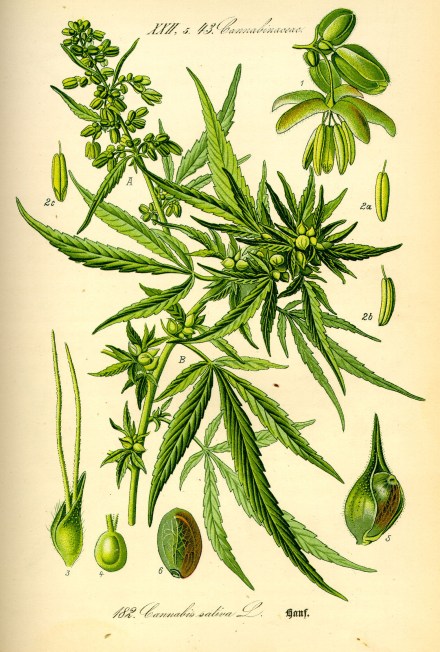
Illustration, Cannabis sativa, 1800s. Permission granted to use under GFDL by Kurt Stueber.

The Ultimate Guide to Hybrid Strains of Cannabis

Even if you’re new to the world of marijuana, you’ve probably heard names like Skunk #1, NYC Diesel and White Widow. These are just some popular examples of hybrid strains of cannabis.

Thanks to hybrids, you don’t have to choose between marijuana that is strictly indica or sativa. Today, most of the cannabis strains you encounter are of the hybrid variety. 

What is a Hybrid Strain?

There are two basic types of cannabis plants: indica and sativa.

Sativa strains are notorious for making users feel energetic and happy. Cannabis indica, on the other hand, is generally considered relaxing and mellow.

The vast majority of cannabis strains are hybrids, which means they combine the best properties of both kinds of cannabis. They are deliberately crossed by cannabis breeders to include properties of both indica and sativa strains.

A Question of Dominance

Some hybrids are balanced evenly, with a 50/50 split on both the indica and sativa side. These are called balanced hybrids. Not very many hybrid strains of cannabis are evenly divided.

Most hybrid strains of marijuana are indica dominant or sativa dominant. These types favor one side over the other and you can choose based on your personal preferences.

If you want more of an energetic, cerebral high, but with some of the added benefits of an indica to relax your body, then you would choose a sativa dominant. Those who would prefer more of a physically relaxing experience but a milder buzz would enjoy an indica dominant. 

This is not only an interesting challenge for cannabis breeders, but creates a myriad of choices for consumers with varying preferences..

By My 420 Tours – Own work, CC BY-SA 4.0, https://commons.wikimedia.org/w/index.php?curid=69349115

The Science and the Effects of Hybrid Cannabis

The idea behind creating hybrid strains is more than just combining two different types of weed.  Anyone can put a seed in the dirt for fun. Professional breeders use complex knowledge about genetics and Mendel’s laws of inheritance to create plants that win awards and become internally renowned.

Sometimes hybrids are created to make a cannabis plant more hardy, increase production or control their size.

Cross a tall sativa with a shorter indica so the plant can grow indoors. Indica genetics will take the cerebral edge off a powerful sativa and give it a more mellow effect, or thicken the resin and make the plant more suitable for making cannabis products such as hash or budder.

There are literally thousands of different combinations and possibilities.

Canadian growers like Jordan of the Islands have a reputation for crossing tall sativas with shorter indicas. This gives the plants a tougher edge to grow outdoors in the northern rain forest or shorter height so the plants can stay indoors. The practice has resulted in some stellar hybrid marijuana strains like God Bud and Blue Shiva.

The Roots of the Hybrid Strains

photo: http://trimready.com

Cannabis indica and cannabis sativa trace their origins back to two major regions; modern day India and Central Asia. Marijuana aficionados from around the world have worked with these two basic elements to create thousands of modified final products.

Modern travel and tourism have also been a big contributor to the many new hybrid cannabis strains. Cannabis tourism and global seed sales are now mainstream industries and are a subculture onto themselves.

These are a few international locations that have been the most influential to the creation of the vast majority of today’s hybrid cannabis strains. 

India

The medical use of cannabis has always remained legal in India and several states recreational use used to be permitted, but the authoritarian government of Modi has restricted the practise.

The history of the cannabis plant traces some of its earliest origins to India where it was (and continues to be) celebrated in festivals, used in food, and forms an integral part of Ayurvedic medicine. Plants that originated in India are indica dominant.

Thailand

We’re not sure what drew the tourist trade here first, the breathtaking landmarks or legendary stories about the Thai Stick strain. Either way, this south Asian paradise has given the world some of the most impressive hybrids with an emphasis on sativa strains. Until a brutal crackdown that started in 2003 (courtesy of Prime Minister Thaksin) Thailand was a safe and tolerant haven for cannabis users. Today, even more so, thanks to legalization.

Hawaii

A mix of rich, volcanic soil and a humid tropical climate means an ideal growing area for potent sativa strains. Maui Wowi and Kona Gold are just two of many famous plants that trace their ancestry back to Hawaii and the surrounding islands. Many of the oldest strains that have been historically cultivated on these islands have been lost or gone extinct. Others have simply been pushed out by foreign imports.

Mexico

“I got the plug on Oaxaca.”

The lyrics in Childish Gambino’s song, “This is America” contain a reference to the state of Oaxaca in Mexico’s southernmost region in regards to drug trafficking. Mexico’s association with marijuana is deeply ingrained in North American pop culture. The sunny slopes of Mexico are ideal for sativa dominant hybrid strains, and plants from south of the border include famous names like Acapulco Gold and Mexican Sativa. Mexico is ahead of the curve when it comes to legalizing medicinal marijuana and CBD, but the cartels still use cannabis as a cash cow.

Afghanistan

The indica side of the marijuana hybrid strain has its earliest origins in Afghanistan. The Kush family of marijuana strains, a group of hybrids with an indica dominant lineage, traces its history here. Legend has it this is also where the first varieties of hashish were developed, which is likely given these varieties are heavy in resin.

Consuming Hybrid Strains of Marijuana

Yet another great thing about hybrids is their versatility. You don’t have to choose based on effects alone. Modern breeders have created varieties that taste, smell, smoke, vaporize or cook exactly the way you want.

Whatever your preference, from advanced vaporizers to that classic hand-rolled joint, there’s a type of cannabis hybrid for you. Other forms of cannabis that are currently available include extracts and oils along with a wide variety of edible products.

Medical users that need to be discreet but also require frequent use and quick results can use their hybrid of choice with a small portable vaporizer. Those who are handy in the kitchen can either buy cannabis-infused cooking oil or follow a handy recipe to make their own.

The Most Popular Hybrid Strains of Cannabis

Some of the most notorious hybrid strains of cannabis are associated with interesting urban legends. Many notable hybrids are attributed to the work of modern breeding companies and have won global awards. They are famous as ancestors of other types of marijuana, leading to a whole new generation of strains.

Occasionally the names of the original breeders and exact genetic background have been lost to the ages. Some strains of hybrid cannabis become so popular and prevalent that their genetics essentially become part of the public domain.

Here are a few interesting stories that you might hear or share at the local Compassion Club. The following strains are famous for their notable pedigree, appearances in popular culture and their contribution to other modern strains.

White Widow

An indica-dominant strain from India’s cannabis cradle was crossed with a potent Brazilian sativa, and the result was the iconic White Widow. This hybrid strain was bred in the Netherlands more than 20 years ago with from plants had origins in the Kerala Mountains of southern India.

The other “whites” like White Rhino, for example, have a similar lineage. The White Widow shines with a thick layer of frosty, sticky trichomes, hence its name. The high is energetic and sustaining but also has a pleasant relaxing effect, with a 60/40 balance that’s heavy on the indica.

Skunk #1

Skunk #1 could be one of the first strains to be bred and grown on a professional level, the genesis of what would become a billion dollar industry. It was so well-known and widely consumed that virtually all types of cannabis were simply referred to as “skunk” back in the 1970s and early 1980s. The strain itself was often known only as #1, which was specific enough given its massive popularity and notorious aroma.

A hybrid originally bred by the Dutch company Soma Seeds the 1970s, Skunk #1 hovers in the neighborhood of 65/35 indica dominant. Skunk mixes the best of several strains from all over the world, including Thai, Afghani and Mexican, but it’s exact origins and family tree are unknown.

Jack Herer

This is a name you’ve heard spoken with reverence in any community that consumes and uses the cannabis plant. Jack Herer is a hybrid named after the author of a book called The Emperor Wears No Clothes which is a comprehensive collection of myths, history and facts about cannabis. Like the book, the strain is an ideal choice for those that are not yet familiar with cannabis but would like to learn more.

Jack Herer is another creation from across the pond, this time from renowned breeder Sensi Seeds based in the United Kingdom. It’s one of the few truly balanced hybrid strains of cannabis with an even 50/50 in terms of sativa versus indica effects. The Dutch authorities have acknowledged its medical uses and the strain has won several awards and competitions.

OG Kush

A lasting testament to the brilliant growers and breeders of California, the myriad of choices with “Kush” in the name can be traced back to this famous strain. Many in the current industry compare its modern influence to the vintage Skunk #1 of the bygone hippie days, especially in the sense that it lent its name to so many other strains and even grew to be another word for weed itself.

Legend has it that the original breeders were based out of Florida, then moved their operations to Los Angeles in the 1990s. OG Kush appeared on the market in 1995 before taking the cannabis world by storm at the turn of the century. Other famous Kush names include Bubba and Lemon. Virtually all varieties of Kush are known for being close to balanced, with a slight favoritism towards the sativa side at about 60/40.

Pineapple Express

Made famous by the film of the same name, Pineapple Express was already one of the more popular hybrid strains in Holland before it appeared on the silver screen. The name itself is a clever callback to the famous parent plants, with Hawaiian on the sativa side and Trainwreck on the indica side.

The original breeders are unknown, but the folks at Barney’s Farm in Amsterdam currently offer an auto-flowering variety. Although the combination is not far from a balanced hybrid at 60/40, this strain is recognized for its energetic and long lasting high which which is often associated with stronger sativas. It has a distinctively fruity taste and smell.

Juicy Fruit

Another significant contribution to cannabis culture from Sensi Seeds, Juicy Fruit, a.k.a. Fruity Juice, is the product of two heavy hitters. This hybrid strain is the product of a classic Thai sativa and an old-school Afghani indica. It’s very close to a balanced hybrid like its compatriot Jack Herer, but leans slightly more to the sativa side with a 55/45 split.

The story of how Sensi Seeds perfected this particular plant is an adventure that literally took decades. The plants were difficult to isolate and finally breed into a plant that could grow under almost any conditions and present such a typical example of both parents. The exotic taste and smell recall this hybrid strain’s exotic heritage.

Himalayan Gold

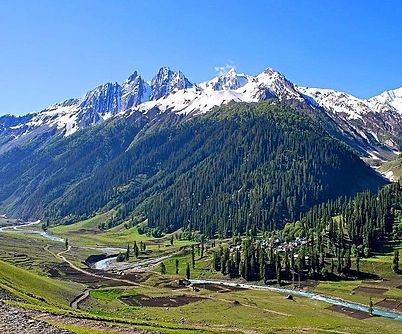
The Kashmiri Mountains of Nepal and Northern India are home to some of the oldest cannabis genetics in the world. India is home to the indica variety and Nepal has contributed to the sativa side. It makes logical sense that this geographical area would be the first to combine the two.

Sonmarg Valley in Kashmir, By Biswarup Bhattacharjee – Own work, CC BY-SA 4.0, https://commons.wikimedia.org/w/index.php?curid=49795885

Nobody is sure who succeeded first, but we do know that a strain called Himalayan Gold was making headway into cannabis culture as early as the 1960s. Various companies have bred different versions that include some feminized varieties.

The indica side of Himalayan Gold is the dominant influence at 60/40, but it can grow to sativa size, about five feet, if it’s grown outdoors.

NYC Diesel

This hybrid strain is also known as Soma Sour Diesel, a reference to the breeder that created the strain. Amsterdam based Soma Sacred Seeds currently sells the classic version of this now-famous strain. It has won nine Cannabis Cup awards, two of which have been first-place showings.

NYC Diesel is a what happens when modern cannabis breeding goes truly international. It was originally developed in New York, a cross between a classic Mexican sativa and an Afghani indica, touched by every corner of the planet. The strain is on the sativa-dominant side at 60/40 and is known for a distinctive fruity smell.

God Bud

God Bud distinguished the breeders of Canada’s West Coast as some of the best in the world when the practice was still fairly new north of the border. It was the flagship strain of the original developer, BC Bud Depot, which also developed strains like Blue Dream and Girl Scout Cookies.

God Bud is hard to find in its pure form today, but is the basis for several of their other notable hybrid cannabis strains. The genetics are a mix of Hawaiian sativas and some of South Asia’s most powerful indicas, making this an indica dominant hybrid. This is one of the less-balanced entries on our list, with a 75/25 division. 

Thai Lights

You’ve also heard this cannabis variety referred to as Thai Stick, another famous classic that dates from the hippie days. This sativa dominant hybrid strain is only available through certain Canadian seed banks.

The exact genetics come from the mountains of northeastern Thailand, an area known for its sativas, and the notorious indica-dominant hybrid strain Northern Lights.

The plant is close to balanced at 60/40 favoring the indica side. Like most plants that come from Canadian companies, the plant is designed to grow indoors and does well in smaller spaces.

Are Marijuana Hybrids Right for You?

Browsing the many different types of cannabis strains and finding the right one for you can feel overwhelming.

Do you need to stay focused while medicating? Choose a hybrid that’s indica dominant but with a strong sativa pedigree.

Are you using cannabis to relax after work but still want to stay active? A hybrid strain of marijuana that favors the sativa side is an ideal choice.  

Are you looking for something can combines a benefit like pain relief with a happy, social feeling? Try a balanced hybrid strain that combines both recreational and medical effects.

Consider discretion, safety and security when choosing both your ingestion method and your preferred hybrid strain of cannabis. Take your time and enjoy everything hybrids can offer.

Chapter 3 – Stowaway

“Didn’t Hoshi say she was going to the bridge?” Selek asked as they walked into Sick Bay.

Dr. Phlox was standing next to a bushy potted plant crowned with a few spiky purple flowers, peering at a small wooden box mounted at eye level on the wall. A light bulb that was suspended a few feet above it was fading, so slowly that the change was barely perceptible.

Another person was bent over the wooden box, peering at it with some interest.

“How is she, Doctor?” They asked, leaning close to one of the few bits of natural wood anywhere on the ship.

“Sealed up for the night, as you predicted,” Phlox replied cheerfully. “The incandescent light and the 24-hour cycle seem to be helping. But this plant you thought of? It’s lovely! So fragrant. What’s it called again?”  

“Basil.” The bent figure carefully rose into a standing position and turned around. “Much easier to grow than orchids.”

Selek’s eyes widened. It was the Chief Engineer of the Enterprise, Charles Tucker III.

“Are you checking on Dilemma at bedtime too?”

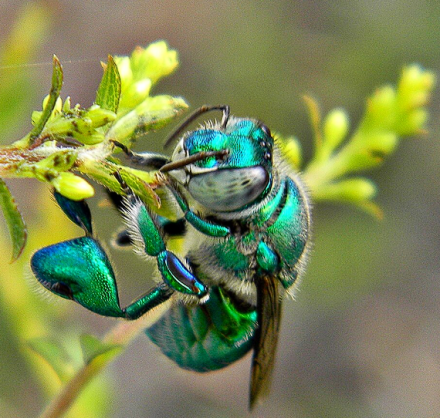
The two of them chuckled at the nickname that Trip had given the insect, which was a reference to her Latin name, Euglossa Dilemma, a type of green orchid bee.

“It’s become a habit, but I give the same attention to this whole menagerie at night. You seem to have a special bond with her.”

“Well, I admit, I feel responsible,” Trip replied.

The bee had appeared in Tucker’s quarters, likely a stowaway in his luggage. The species was common in his central Florida home.

By the time she was discovered, they were already well out of space dock, and it was too late to send the bee home. After rescuing her from the perils of the neon lights, she was brought to sick bay and made as comfortable as possible.

The Doctor already had several unique animals in his care and the Green Orchid Bee was a natural addition to the ship’s menagerie. Between him and the Engineer, they were able to construct a suitable home and produce a suitable diet for their guest.

Her next stop, outer space.

The bulb was dark and cold now, and the small opening at the top of the box was sealed with something that looked like wax.

“The ironic thing is, they got to Florida the same way,” Trip said softly, as if to avoid disturbing the small resident within. “As stowaways in wooden pallets, almost 200 years ago.”

“Chef loves it,” Phlox turned his attention back to the plant nearby. “He’s been coming down for leaves almost daily.”

Selek recognized the same kind of plant that his mother had given as a donation to the temple when he had taken up his duties. The one T’Nedara had asked him about it when he met her in the kitchen that night. It was difficult to keep his mind from wandering back to that fateful evening.

“Speaking of Chef, I’m late for dinner,” Trip straightened up and headed for the door. “Take care, Doc.”

He nodded towards Sick Bay before walking through the sliding doors.

Selek watched him leave and resisted the urge to follow. He waited a moment until the doors shut, then turned his attention back to Ah’len and Phlox.

“I should bring him a cutting,” Phlox thought out loud, thinking of the Chef, as he squinted at the leaves. “The ship needs more plant life anyway.”

            A sharp whistle sounded over the comms.

All crew are ordered to return to their stations. This is a yellow alert.

            “So much for dinner,” said Phlox.

            “Why the alert?” Selek asked, as they stepped calmly back into the corridor.

“An incoming Andorian ship,” Ah’len replied. “It’s a battle cruiser, but so are most of them. It’s the Kumari, under the command of friendly enemy Commander Thy’lek Shran. He’s come before, but this time we’re ready and the plan was set.”

“Wait, how did you know they were coming? What plan?”

“A plan within a plan,” she smiled.

“I recognize the Frank Herbert quote, despite the slight variation.” Selek raised an eyebrow at her.

“I suspect you’ve already figured most of this out,” she said, partly to challenge him. He replied without a shred of doubt.

“I deduce that Shran has a legitimate plan to gather scientific information, but he secretly wants access to whatever Hoshi is working on. This is connected to what you, myself, and the Klingons want on Romulus.”

She nodded, smiling. The communications officer was likely translating the verbal component of the initial contact at this moment, and any information about the ship was essential to handling the situation.

“It’s uncloaked and approaching at low speed, so first glance seemed to indicate that their intentions weren’t hostile.”

The Andorians weren’t enemies with the humans, but the two races were on suspicious terms.

“Selek,” she turned to her guest. “I’m sending you to follow Captain Archer around for a while. I know you want to see the bridge anyway. Everything you see really happened. You can even ask your mom.”

Before he could respond, Selek blinked and found himself in the Captain’s private office. There was a hiss, and a visibly agitated Captain Archer strode in and flipped a switch on his desk. An Andorian flickered on the viewscreen.


[1] https://en.wikipedia.org/wiki/Euglossa_dilemma

Chapter 2: The Enterprise NX-01: Star Date 2152

            Selek stared with some trepidation at his surroundings. His friend seemed to notice his discomfort.

            “You can speak and move freely,” she explained. “This is just a memory. Think of it as a dream, or what do they have on earth? Pretend it’s a show. You’re safe in hibernation mode for the moment while I…”

“Where? What happened to…”

“I’ll explain later. For now, I can tell you the crew is safe, in long term sleep just like you are. I’m Captain Ah’zhen, and I’m accessing the dream sequence in your brain with the help of some Xyrillian technology to recreate this reenactment. Sorry about the Kir’Shara, but there was nothing we could do. You can build another one.”

Selek barely had time to raise an eyebrow before she continued.

“Your mother is going to finish her briefing near the Mess Hall. Here we are. See that lady over there?”

            Selek blinked and recognized one of his mother’s crewmates, Communications Officer Hoshi Sato.

            “Go and find out what she’s doing. I’ll see you again soon enough.”

Hoshi was sitting with a fork in one hand and her tablet in the other, a colorful pasta salad remaining mostly untouched in favor of the monochrome screen.

Selek was shocked, to say the least, but understood he was safe for the moment, and was distracted with a view of the antique Enterprise.

He walked over to the table, paying close attention to the details he’s read so much about in school and heard about at home. He recognized other faces and understood generally where he was located on the ship.

Nobody else took any notice of him.

Travis Mayweather came to the same table, carrying a dinner tray. Selek stood next to them, listening carefully.

“You busy?” He asked, nodding at the tablet.

“Actually, no,” she squinted at the screen, which was scrolling through what looked like a large catalog of schematics and letters of non-Terran origin. “Just going through some of the information we found during the mission to P’Jem. How’s the bridge tonight?

Mayweather and Hoshi chatted idly for a while, enjoying dinner and ignoring the tablet, which seemed to be running on its own.

After a few minutes, it stopped and flashed from green to blue, prompting Hoshi to pick it up again.

“Oh, it’s done,” Hoshi smiled and leaned closer to the tablet. “Fascinating!”

            “It?” Mayweather raised his eyebrows as he spoke.

            “The ship’s cryptologists have been working on the pictograms. It looks like my team has deciphered most of it.”

             “Was that the Vulcan data that mentions the Sanctuary? The one the Andorians say is a front for a surveillance network?”

Selek tensed up and leaned forward. The destruction of P’Jem was the first incident to put his mother on the Vulcan High Command’s radar, and the attention was not positive. However, it seems that this was early in the history of the Enterprise, and P’Jem was still intact.

“It is. These fragments seem to pre-date Surak, and we’re not sure how that’s possible. Are you going back to the bridge?”

            “Heading back now. See you up there.”

            Selek was tempted to follow Mayweather. He was secretly hoping to see Jonathan Archer and get a good look at the helm, but resisted the temptation and continued to follow Hoshi. He was also looking for fragments that pre-dated Surak. The humans seemed to have found something similar and it led them to the Sanctuary.

            They walked towards the computing and data storage section of Engineering, a section of the ship that Selek didn’t know very well.

            Hoshi opened the narrow panel and squeezed into the enclosed space. Not all of the computers on the Enterprise were designed for optimal human interaction. The ones in the computer core, located in a section one deck below the bridge, were service consoles with a limited interface.

The cryptology team consisted of several members, and today each one was working at a computer console to translate and sort the files from P’Jem. She took a briefing from each.

            “Are these the files from the Sanctuary?” Selek asked, looking over Hoshi’s shoulder.

            “Yes,” Ah’zhen answered, “these files are related to what you’re looking for, but whatever is hidden on Romulus must be even older.”

The two of them went through the same panel to leave the room, but Ah’zhen motioned Selek in a different direction.


Vulcan Biometrics – Part Two

Chapter 1 – The Xyrillians

Selek couldn’t see anything, but the sound of two voices nearby made him feel like a child hiding in a dark closet, eavesdropping on a private conversation.

Go ahead and look, you’re the one with a human ancestor. Careful, it’s your first Vulcan.

Another replied after a few moments.

Lots of great stuff here. Military and survival training, a real sword master. He’s the type who knows when to keep his mouth shut.

Don’t get too distracted. What else?

There was another pause before the voice continued.

Some fun details. He likes spicy noodles. His favorite band is The Smiths. Typical Vulcan, likes males as much as much females. Prefers melee to ranged fighting but he’s a decent archer. Interesting times at the Military Academy. The stars in the desert are something else. But…oh? Wait…

Selek didn’t feel it, but he heard something like a metallic thud, and had the distinct impression that someone had just walked into a wall mid-sentence.

The first voice replied with a laugh.

I warned you, Vulcans can do that. What did you see?

He fought the Kal If Fe recently. Some of the scars are permanent. I can see his mate, but…She’s wearing some kind of bag? Ow, it smacked me hard!

He’ll never let you in there. They teach them how to block almost everything in childhood. Vulcans are composed until it comes to mating, then they literally go insane. Come on, we don’t have much time.

The darkness shuddered and broke, dissolving like a thousand insects disturbed by a sudden light.

It’s not exactly a dream, the second voice said, it’s a memory. You can’t get hurt. Don’t be afraid.

Selek opened his eyes. He thought he was back on the ship for a moment.

He was standing in a corridor, behind a door with a large window, and had a clear view of the room inside. It was not filled with his Vulcan crew, but lined with humans, and they were wearing a vaguely familiar uniform.

A row of cadets was standing at attention to his left. His eyes ran down the line and stopped at the end. The last cadet in line was looking at the window, towards him.

Except that they didn’t seem to be a cadet. Selek didn’t expect every ensign on the Enterprise to be human, but this was a Xyrillian, and although this race was known to humans they weren’t serving on each other’s ships. Those kinds of partnerships were still at least decades away.

Plus, she seemed to be wearing a Xyrillian uniform, and with the symbols that denoted her as Captain of her own ship. He guessed from her size that her sex was female.

What was she doing here?

What was he doing here?

Where was here?

She smiled and waved.

Selek jumped a bit. It was not a mistake or coincidence. She was looking straight at him.

Then she discreetly pointed to the person who was speaking to the troops and walking towards the door he was standing behind.

There was a hiss, the door opened suddenly, and Selek caught his breath. A younger version of Sub-Commander T’Pol strode through the door and down the hallway. A line of cadets followed and the one that had spoken to him was the last to leave.

“Selek!” The Xyrillian smiled at him as they strode by. “Welcome to the Enterprise!”

            And she gestured for him to follow.