
By Kristy Ambrose
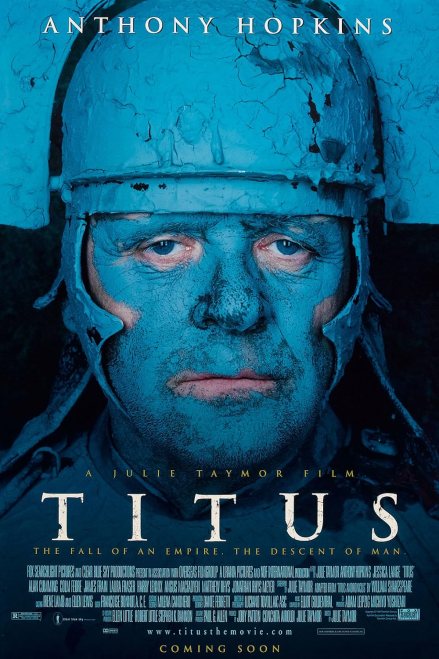
Anachronism is a theatrical device that places something modern in an old or ancient setting. Although this technique is associated with postmodern cinema, plays from the Middle Ages also utilize anachronism. Shakespeare used the technique to make allegorical references to contemporary themes and political figures. This connected the mentality of his audience with the drama on stage. In modern Shakespearean adaptations, anachronism is often utilized for the same purposes. One of the richest examples is Julie Taymor’s 1999 film, “Titus.” The film uses music, costuming, and set design from various eras, with a special emphasis on the 20th century, in a Classical Roman setting. This use of anachronism helps convey the timeless themes within the play and gives the modern audience a frame of reference.
Shakespeare’s play Titus Andronicus is unique among the Bard’s work for several reasons. Unlike other plays that use a setting from Roman antiquity, such as Julius Caesar, the characters and events of Titus Andronicus are wholly fictional even if the era is not. It contains extreme examples of the death, violence, and evil schemes that are scattered throughout the tragedies. Elizabethan plays were known for their reliance on shock value when it came to drama, and Titus was written at a time when the practice was actually fashionable. This is not one of the most popular plays when it comes to theater productions because of the horrific subject matter, and that’s as true for now as it was in Shakespeare’s time. (Ebert)
One thing that is fairly new is the concept of adapting stage plays for the silver screen. A Shakespearean play often has to be edited to fit into the common three act structure that defines most films. In the case of Titus, some speeches are rearranged and scenes are in a different order than the play. The dialogue itself is quite faithful to the play, with some lines omitted or paced elsewhere, but nothing is added. (Titus, 1999) There are some extra scenes added at the beginning and end but these do not contain dialogue. You can follow the text of the play as you watch the film. (Shakespeare).
The backdrop of the theme, imperial power and perpetual war, connects to the underlying theme of war. The opening scene is not in the play and takes place in a contemporary kitchen. The vintage furniture and fixtures date from the 1960s and the toy soldiers cover a variety of eras. There are Roman soldiers along with soldiers from a modern army on the kitchen table. The child is carried from the modern house into a Roman amphitheater. This transition from modern to ancient is jarring and sudden and i meant to guide the audience from their own time into a much older one.
“Titus” was filmed in Roman ruins throughout Rome and the amphitheater featured in the beginning and opening scenes is located in Croatia. The play and the film are set in an unspecified historic period and the anachronism in this scene emphasizes the ambiguous historical time frame. The following scenes, in which the dead soldiers are interred and Alarbus is sacrificed, are virtually devoid of anachronism except for some details on the uniforms of Lucius and Titus’ other sons. In the play, this is the second scene, but it is moved to the opening in the film. The sacrifice of Alarbus is the “major reversal” that sets the rest of the story in motion and takes place within the first ten to fifteen minutes of a movie. Introducing the title character first is also preferable for this medium so the audience knows exactly who he is.
As we move to the debate of Bassianus and Saturninus the time period shifts again, This time, the audience again follows young Lucius to a setting that could be any political uprising. We are back in modern times again, but not the 1950s kitchen. The clothing, music and even the hirstyles reflects the Fascist philosophy of 20th century Italy and, the hedonistic music is reminiscent of 1920s big city life. (Ebert).
Saturninus is marked out as a villain partly because of his modern clothing and hairstyle. He and his rival, Bassianus, are both dressed in modern clothing. They drive cars and use microphones that would date from the 1920s. It is in this scene that we see how color is used with anachronistic features. Each faction has different flags. The colors of traditional Rome have already been established as black, white and light blue. Bassianus is flying blue and white banners as he approaches the capital building. The banners of Saturninus are red, orange and back, a contrast to the muted colors of his brother and in a pattern that recalls the modern German flag. His haircut is reminiscent of the clean-cut styles often worn by Nazis and his black suit mimics a Nazi Gestapo uniform.(“Good Hair, Evil Hair.”) The announces his intentions to rule Rome before the capitol building, which is not Classical but instead mimics modern Fascist architecture. The references to Nazi Germany could hardly be more stark.
Anachronism is used in this part of the film to help introduce main literary themes. There’s the conflict between traditional and modern, symbolized in the younger Bassianus claiming the throne despite his less-qualified older brother being first in line. A more compassionate and qualified ruler can be defeated by a more populist authoritarian one. Titus himself is often shown in traditional Roman military uniform, which is steadily shed as his misfortunes mount.
The two main female characters, Lavinia and Tamora, wear both traditional and anachronistic costumes and hairstyles. The colors used in their costumes is also significant. Tamora is introduced first in the traditional clothing and attire of an ancient Goth. When she is presented as part of the spoils of conquest to Emperor Saturninus from Titus, she is dressed richly in gold. This puts her in contrast to a film palette that is mostly white, light blue or black. Lavinia is always in either black, white, or grey. The only other color we ever see on her clothing is the red of her own blood.(“Titus.”)
Lavinia first appears in a black dress and veil, the cut and style of which is reminiscent of Jackie Kennedy. This is a callback to the opening scene which was set in the same 1960s era and an example of traditional modern clothing. As the daughter of Titus, Lavinia embodies the best and most pure example of Roman piety. This is symbolized by her conservative, anachronistic clothing and her entrance, to pay her respects to her fallen brothers and victorious father in their family tomb.
The Andronicus family tomb is darker than the Senate chamber and throne room, but other than lighting there is little difference in color. When we see Lavinia in the Senate chamber as the intended of Saturninus, she is wearing the same black dress. In the same scene, Tamora is dressed in a golden breastplate and gold is woven into her blond hair. She embodies the spoils of war and how easily compulsive lust and unlimited riches can corrupt a weaker man. Saturninus admits as much when he sees her by referencing her unique appearance.
On lines 288 and 289 in Act 1 Scene 1 he says, “A goodly lady, trust me; of the hue / That I would choose, were I to choose anew.” (Shakespeare). A similar device might have been used in Elizabethan times to portray Tamora as a powerful character.
Strong colors and modern but less conservative clothing are used to distinguish the main villains throughout the film adaptation. They are connected with symbols of ruthless imperial power from the modern age. The wedding feast of Emperor Saturninus and Empress Tamora is a picture of decadence. It takes place in an interior amphitheater decorated with murals and centered around a luxurious pool. This is one of the more colorful sets in the film and also one of the most historically accurate. (“Titus (1999)”)
The music dates from the early 20th century, the clothing ranges from the Classical time period to contemporary designs. We have a rich Roman banquet combined with a swinging Prohibition-style party. Saturninus is still dressed in the same era of clothing but more white than black. Tamora wears a modern sequin gown. She’s literally in gold from head to foot. Modern audiences would recognize these symbols of wealth and power. These eras were also indicative of a time when wealth meant ignorance and power meant corruption. Rome eventually fell apart and the excess of 1920s dissolved into the Depression of the 1930s.
The villains of Titus will also fall, in a dramatic bloodbath that is actually fairly tame compared to other tragedies like Hamlet. The setting is the rustic dining room at the Andronicus estate, which is deliberately designed to fit into any or no time period, but the guests are attired in modern clothing. Titus himself is wearing a clownish chef’s outfit, which dates from the 18th century, Lavinia appears in a white dress with a modern cut that mimics a burial shroud, while Saturninus and Lucius are still wearing modern military uniforms. Both Saturninus are dressed in white and gold. The clothing of Lucius and the Emperor is a reminder that this dinner is a military negotiation and tensions are already high. Tamora stands out again in gold braids similar to the scene in the Senate, reminiscent of the lust and greed that drew the young emperor to her side.
As the film closes, the audience once again follows Young Lucius to a somber but hopeful resolution. He is wearing a modern white suit that could be for both his father’s coronation and his grandfather and sister’s funeral. The play that began with a messy game of war ends with a peaceful sunrise and two hopeful children walking from the ancient ruins into the horizon. By returning to the present era at the end of the film adaptation, director Julie Taymor takes the modern audience out of the surrealistic nightmare of Titus and back to waking reality. (“Titus (1999)”)
The use of anachronism in the play serves an important artistic function. Titus alienated many in Shakespeare’s time with it’s violence but many others were drawn by this same thing. Today’s audiences are equally fascinated by horror, evil plots, and death. The universal themes of revenge, greed, lust and even squabbles between lovers and family members are still featured in movies and television shows as a source of drama and intrigue. Anachronism helps an audience in the modern era understand these timeless concepts as part of their own personal experiences.
Works Cited
“Good Hair, Evil Hair.” TV Tropes, tvtropes.org/pmwiki/pmwiki.php/Main/GoodHairEvilHair.
Gabe Moura. “The Three-Act Structure.” Elements of Cinema – A Student’s Guide to the Fundamentals of Filmmaking, http://www.elementsofcinema.com/screenwriting/three-act-structure/.
Roger Ebert. “Titus Movie Review & Film Summary.” Movie Reviews and Ratings by Film Critic Roger Ebert, http://www.rogerebert.com/reviews/titus-2000.
“Titus.” Directed by J Taymor, Clear Blue Sky Productions Overseas FilmGroup Urania Pictures S.r.l. NDF International. Film.
“Titus (1999).” IMDb, 21 Jan. 2000, http://www.imdb.com/title/tt0120866/?ref_=ttrel_rel_tt.
William Shakespeare. “Titus Andronicus.” Open Source Shakespeare, http://www.opensourceshakespeare.org/views/plays/play_view.php?WorkID=titus&Scope=entire&pleasewait=1&msg=pl.
Bibliography
“A Brief History Of The Chef’s Uniform.” Escoffier, 17 Feb. 2016, http://www.escoffier.edu/blog/culinary-arts/a-brief-history-of-the-chefs-uniform/.
De Grazia, Margreta, et al. “Anachronism.” Cultural Reformations: Medieval and Renaissance in Literary History, Oxford UP, 2010.
Ebert, Roger. “Titus Movie Review & Film Summary (2000).” Movie Reviews and Ratings by Film Critic Roger Ebert, 21 Jan. 2000, http://www.rogerebert.com/reviews/titus-2000.
Moura, Gabe. “The Three-Act Structure.” Elements of Cinema – A Student’s Guide to the Fundamentals of Filmmaking, 29 Nov. 2017, http://www.elementsofcinema.com/screenwriting/three-act-structure/.
Grasso, Joshua. “Creative Anachronism in Imaginative Fiction.” Medium, 19 Dec. 2018, medium.com/@joshuagrasso_58239/creative-anachronism-in-imaginative-fiction-7e661ba7001b.
Marcus, Leah S. “Chapter 7, Editing Shakespeare in a Postmodern Age.” A Concise Companion to Shakespeare and the Text, 1, Wiley-Blackwell, 2007, pp. 128-144.
Shakespeare, William. “Titus Andronicus.” Open Source Shakespeare, http://www.opensourceshakespeare.org/views/plays/play_view.php?WorkID=titus&Scope=entire&pleasewait=1&msg=pl.
“Titus (1999).” IMDb, 21 Jan. 2000, http://www.imdb.com/title/tt0120866/?ref_=ttrel_rel_tt.
Titus. Directed by J Taymor, Clear Blue Sky Productions Overseas FilmGroup Urania Pictures S.r.l. NDF International, 1999. Film.
“Titus.” TV Tropes, tvtropes.org/pmwiki/pmwiki.php/Film/Titus.
 Cristina in Oaxaca