
Galileo expected the telescope to quickly make believers in the Copernican system out of all educated persons, but he was disappointed. He expressed his discouragement in a 1610 letter to Kepler: “My dear Kepler, what would you say of the learned here, who, replete with the pertinacity of the asp, have steadfastly refused to cast a glance through the telescope? What shall we make of this? Shall we laugh, or shall we cry?” It became clear that the Copernican theory had its enemies.
…
In the 1633 trial of Galileo Galilei, two worlds come into cosmic conflict. Galileo’s world of science and humanism collides with the world of Scholasticism and absolutism that held power in the Catholic Church. The result is a tragedy that marks both the end of Galileo’s liberty and the end of the Italian Renaissance.
From: law2.umkc.edu/faculty/projects/ftrials/galileo/galileoaccount.html
Advocates of marijuana legalization are feeling frustrated these days. For almost a century, marijuana prohibition has endured despite every effort of the anti-Prohibitionists to counter this alarmist and misguided social policy with facts, studies and logic. As anti-Prohibitionists as fond of pointing out to their opponents, it’s insane to do the same thing repeatedly and expect a different result. So, if proponents of legalization would take their own advice, what is the next step in what seems to be a perpetually losing battle?
“Legalizers” (for lack of a better word at this point) are heavily focused on the results of their efforts. The legalization movement focuses almost exclusively on a result, the legalization of marijuana. Instead of trying to break or damage the Prohibitionist ideology, the legalization movement should build another ideological system to compete. This competing system will empower more marginalized groups by demonstrating what they all have in common with anti-Prohibitionists and appeal to the last of the most reefer-mad voter.
Logically, the lies that prop up Prohibition should be successfully countered by the truth and hard facts, but this is an oversimplification. Prohibitionists don’t care about the truth or the facts. What exactly do they care about, and why? Prohibition advocates are more focused on the efforts they make to achieve the result. This is why they are not affected by the logical assertion that “Prohibition simply doesn’t work.” The results of the Prohibition are not as important as the efforts made towards achieving that end. It is the effort that drives the Prohibitionists, not the result, and this effort relies heavily on a system of belief that will never be swayed by facts.
Every lie the Prohibitionists tell themselves and the rest of us about pot aren’t really about pot at all. Every myth about cannabis for recreation or medicine that Prohibitionists use is connected to a bigger picture, and ideology driven by very basic human emotions, the greatest of which is fear. Fear is the endless well from which Prohibition drinks, and this is one way of explaining why the Prohibitionists are conditioned to react with screaming hysteria in the face of even the calmest resolve.
When a Prohibitionist sees the green marijuana leaf, it is not a literal depiction of a plant to their eyes. It is a symbol of all their worst fears, common fears that are shared by most people. Some common, non-specific fears are fairly obvious, like the fear of terrorism or poverty. Other more intangible fears include the fear of competing ideologies (ie, environmentalism, which stresses a world that is not human-centric) or self-knowledge (which can be psychologically painful). The leaders of the Prohibitionist movement insist that marijuana is the source of many, if not all, of these real or imagined threats.
“It’s not WHAT they do. It’s WHY they do it.” So says Simon Sinek in his video, “How Great Leaders Inspire Action.” This lecture is more about marketing and product positioning than civil disobedience, but Sinek uses inspirational civil rights leaders like Martin Luther King Jr. to help illustrate his point. His “Golden Circle” is constructed based on what motivates people and why. The anti-Prohibitionists have this backwards. Most of the dialogue of the Legalizers starts with the “what” – the legalization of marijuana, the ultimate goal. But how do we get there, and why should anyone care?
We can view the Prohibitionist ideology of fear in a simplified form using Simon Sinek’s “Golden Circle” diagram as a template.
Why – to protect you from all the bad stuff in the world (crime, poverty, terrorism, sickness, sin)
How – by doing everything we can to eradicate this plant, which is the source of your horrors, and punish anyone who touches it
What – marijuana prohibition
As overblown as the “why” claim sounds, promising all but a chicken in every pot and eternal youth, it succeeds by appealing to the most basic and childlike needs and desires of every human being alive. It also simplifies complex problems and blames a single, outside entity for them, real or perceived, and allows Prohibitionists to absolve themselves of any personal responsibility in their actions to rid the world of this vermin.
Another fringe benefit of the fear factor is that it gives the Prohibitionists the impression that they are constantly being attacked by these malevolent and insidious forces, which justifies their aggression against their opponents as a form of self-defence. This is how Prohibitionists justify jailing otherwise harmless people who are clearly not criminals, like journalists or protesters. This then spills over into totally fictional threats like “the gay agenda” or “the war on Christmas.”
The “why” encompasses the purpose, cause and beliefs of the Prohibitionists. Without marijuana Prohibition protecting society, terrorists and criminals would swarm over society in days, leaving us completely powerless. We just can’t take that chance! This also explains why a Prohibitionist can rationalize their own personal pot use; they don’t include themselves in any of the groups typically associated with marijuana (e.g., environmentalists, “hippies”, youth) so the effort to eradicate marijuana certainly won’t include them.
The Legalization movement needs their own golden circle. We need to recognize and use our own powers rather than work within the framework the Prohibitionists have built. Breaking Prohibition won’t just result in the legalization of cannabis. It will empower the entire human race. And that means everyone. Inclusion is important for the Legalizers because Division is one of the Prohibitionists’ favorite weapons (they keep it right next to Fear in the Authoritarian toolbox).
The Emerald Circle is about inclusion, improving the quality of life of everyone, and freedom from fear, anger and exclusion. Historic context is also important, as the Prohibitionists bristle at the thought of a world that existed without them.
In a very broad sense, the Emerald Circle can look like this…
Why – to improve the quality of life for every single human being on this earth,
How – reducing and even eliminating our dependence on fossil fuels by discovering and developing alternative fuel resources, eliminating corruption in police and government, saving millions in taxes and fees and delays in our court processes related to overcrowding and lack of funds, etc. (pretty much everything that farmers, doctors, economists and hippies been trying to say for the past 90 years),
What – LEGALIZE IT.
The Emerald Circle is just as supernatural in its claims as the Prohibitionist counterpart, and therefore equally unbelievable in nature. It makes more sense, especially if the Legalizers expect to include everyone, to break down the Emerald Circle into specific categories and apply it to different ideologies. For example, for those concerned with factory farming or GMO seeds and crops….
Why – improve food production, availability, affordability and quality,
How – lift the restrictions against hardy and versatile crops that farmers are currently not allowed to seed, grow or cultivate,
What – LEGALIZE IT.
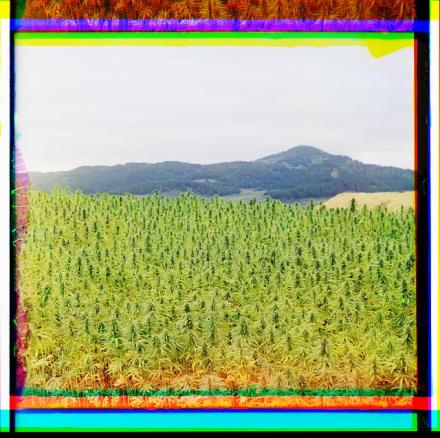
The connections to the bigger picture here include industrialized hemp as well as any seed that has been genetically modified or restricted for farmers to use, like certain types of corn. The Legalizers stand firmly in solidarity with another group, one that opposes genetically modified crops and factory farming but has the same ideological goals. The message is a positive one that focuses on inclusion, empowerment and appeals to those that are concerned about the quality of their food or, on a more extreme level, afraid of starvation. Groups like Monsanto use the fear of starvation and unemployment to coerce both farmers and consumers into accepting factory farming and genetically modified crops. Nor does Monsanto allow its customers to choose what they grow. The message of the Emerald Circle is diametrically opposed to the one that Monsanto (and their supporters) uses. It empowers instead of bullies. It encourages self-sufficiency as opposed to relying on corporations to curate our food supply.
Another example that demonstrates the wider appeal of this philosophy;
Why – lessen the costs associated with health care while at the same time improving the quality and delivery,
How – by allowing patients to use natural and holistic alternatives that are scientifically proven to be effective against a variety of ailments and have been quality produced and tested by experts,
What – LEGALIZE IT.
Concerns about the cost and delivery of health care are serious issues, so anything that can appeal to anyone. This includes any and all patients (remember, inclusion is important) but can be applied to chronic patients that also need expensive prescriptions over long periods of time. In this instance we not only include Legalizers, but also anyone who is concerned about the costs in a general sense as well as the side-effects of prescription drugs that are distributed via the health care system and the ulterior motives of the companies that produce them. Government and insurance companies play on the fear of removing health care entirely when they insist that they must make cutbacks or increase premiums under the guise on improving or even saving the system from total destruction, depriving the frightened and vulnerable of a world entirely without health care. The Emerald Circle combats this feeling of helplessness and empowers patients and doctors alike instead of threatening them.
One more example and perhaps the most poignant considering the driving forces in North American politics these days;
Why – eliminate our dependence on petroleum,
How – by researching and developing alternative forms of clean and renewable energy sources of plastic and other petroleum based products,
What – LEGALIZE IT.
This includes hemp, of course, but can apply to virtually any alternative fuel source. However, no plant is more versatile than hemp when it comes to replacing petroleum, either as a bio-diesel or an ethanol fuel. In fact, Prohibition as we now know it began when the owners and investors of the petroleum industry (which was barely out of its infancy by the 1920s) realized they couldn’t complete with hemp on a level playing field, and played on the racial and moral fears of a naive population to demonize its close cousin, cannabis. This counters the alarmist claim of tar sands “fanbois” who claim that without petroleum we would all have to go back to living in caves, appealing to the basic human fears of poverty or material loss and the general understanding that petroleum is so important that we simply can’t live without it, even though we did so, and thrived as a society and species, for many thousands of years. Just like the Prohibitionists who insist that making plants illegal is a normal practice and is common throughout human history when the contrary is true.
Fighting this false ideology that has been the Prohibitionist gravy train for almost a century by trying to challenge it with facts may seem like the obvious answer but it has proven to be futile. A competing ideology, one that uses the opposite tactics (inclusion where there is division, empowerment where there is helplessness) and appeals to positive human emotions instead of negative ones can succeed where raw data has failed.
The Emerald Circle is not a marketing ploy or a psychological trick. It is the natural evolution of the anti-Prohibitionist movement. The Legalizers need to remind the human race of the positive things they were capable of, and will be again, in a world without Prohibition.
References
Hemp Ethanol Saves the World: http://hemp-ethanol.blogspot.com/2008/01/economics-history-and-politics-of-hemp.html
Simon Sinek, “How Great Leaders Inspire Action.” http://www.ted.com/talks/simon_sinek_how_great_leaders_inspire_action.html
“The Emperor’s Wears No Clothes”, Jack Herer, AH HA Publishing, 2007.
 Cristina in Oaxaca