Winter Morning

The kettle screams like two broken sheets of ice rubbing against each other in the frigid water. No amount of wool and cotton coverings can shield me from that.

Still groggy with dreams, I twist my body towards the window. The early morning is lined with frost and bright with stars and snow. The windowpane is so cold it feels like it could cut into the palm of my hand.

The thick woods nearby are blurred and dark. The lights of the distant road shine against the snow and ice. Sheathed in layers of soft flannel, I stumble to the kitchen and remove the hysterical kettle from the electric element.

It still emanates heat for a few minutes and I stand as close to it as possible, shivering. My mother, the enabler of the boiling beast, appears fresh from her morning jog across the new layer of snow. The very thought of this offends the warm Mediterranean blood that I inherited from my father. I dream of his sunny homeland as I wrap my hands around my steaming mug, which I habitually drink with too much sugar. My mother enjoys a bitter cup of plain tea as she informs me that the cross-country skis have already been waxed. It is far too early to worry about such fashionable frivolities as matching mittens, especially in this dark little corner of the world.

I find a mismatched ensemble of outerwear. By the time I step outside to strap on my skis, my fuzzy extremities are already slightly damp with sweat. The sky has taken on a streaky orange tone and the evergreen outline of the nearby pine forest have become much clearer, cutting into the auburn clouds. The steam is rising in plumes from my mouth but the goo inside my nose is stiff and not quite frozen. I twitch it, like a rabbit, testing the air. It is not too cold to snow.

I stab my poles ferociously and begin to glide forward. The way is familiar and I barely look up. Soon layers of snow and pine needles have closed in over my head. The hum of the nearby streets and power lines disappears as my feet glide down a long dark tunnel of scaly bark and frozen sap.

Every so often I catch a movement from the corner of my eye, and even though I try to tell myself that we are much too close to human habitation to encounter bears or wolves I feel my pace quicken. To emerge from the shelter of the trees is always a tense moment. I expect to feel a sudden, harsh wind to whip across the frozen river and numb my lips and eyes.

This morning the weather is merciful. There is no wind and a light snow is beginning to fall. Even with the scattered grey clouds the glittering white landscape is too much for my dilated pupils, still burning from sleep. My skis slip easily into the tracks made by those who came before me. They branch off at various points along this icy highway; residential homes, the junior high school, the outdoor hockey rink, and finally, the cemetery. I stop for a breath of air by a pile of black and grey marble lined with crusts of snow and icicles. As I peel off my toque and loosen my scarf, a chickadee sings a cheerful morning greeting and his voice echoes hauntingly at the edge of the dark wood. In passing it occurs to me that I would have to kill him and his entire family just to make a decent side dish.

The freshly fallen snow has turned the sidewalk into a mass of brown slush and the skis will move no more.

Years later I sit under the hazy heat of a bustling Asian city. The wind has grown cool as the autumn wanes into winter, and I dream of the day when the soft snow will kiss the city’s smoggy lips.

Vulcan Biometrics – Part 1

An Star Trek Enterprise Fanfic

Land acknowledgement: This book was written on the unceded territory of the Mixtec Nation in Oaxaca State, Oaxaca, Mexico.

Copyright notice: This is a work of independent fan fiction and is in no way affiliated with or used by the Paramount.


“Well, that’s why they say, hot like Vulcan!” Dr. McCoy, “Amok Time.” (Star Trek: The Original Series, S2E1 “Amok Time.”).


Shi’Kaar, Vulcan, Stardate 216

    His eyes might change, Tripp said. Sometimes it happens with human children. They are born with blue eyes, but they change.

    The months passed by and his eyes stayed blue. T’Pol decided it was easier and safer to hide him than to explain him.

    Nobody in this era would have believed it even if she had tried to name Tripp as the father, never mind the social and political implications. The former Chief Engineer of the Enterprise was supposed to be dead, and his present circumstances were a dangerous secret.

    T’Pol was a controversial figure on Vulcan for working so closely with humans already. Rumors that she had given birth to one had deepened the rift.

    Those hysterical, illogical, smelly things. The Vulcan High Command was wise to keep them out of space.

    How could she have lowered herself?

    And what kind of dangerous creature would it be?

Glasses or lenses would hide her son’s eyes, turning them the same lightless hue as any passing Vulcan.

Officially, Selek was the child of Koss, T’Pol’s former husband. Despite him being incredulous initially, since a Vulcan-Human hybrid was thought to be a biological impossibility, he agreed to play along. Just for the sake of scientific curiosity, of course.

Tinsha Monastery, Khomi Province, Vulcan – Star Date 2197

       Selek could still hear the blood rushing in his ears and the echo of the gong. The thin, dry air was heavy with the smell of copper. His lungs contracted, shortening his breath. The pain of his wounds only seemed to enrage him further, as if his muscles could contract and burst from his own skin.

It is said the body is in torment, but the mind remains unclouded.

He remembered everything vividly. The memory of the duel was still fresh, and it was flooding his mind like the pool of blood open and growing on the warm stone.

His breath was short again, and he was choking, gasping to breathe, and failing. The sound was drowned out by a jarring memory of his own rage and the whistle of the tirpan as it swung through the air.

Selek felt the cold of an infirmary bed against his back and understood. T’Nedara was nearby.

           The sea of dark green that had reached up to consume him thinned, and the bells and gongs faded. A coolness touched his forehead and spread to his eyes and mouth.

The rushing in his ears stopped and he heard a familiar voice.

            The mind controls the body

            Control The Mind

            And the Body will follow

Selek exhaled heavily, and felt his joints loosen and his muscles unravel. He took a deep breath, and the air in his lungs seemed to draw him upward.

The prayer was based on Surak’s teachings and was repeated often in the temple. He pushed some air through his mouth and found he could speak again, and repeated the chant.

            The mind controls the body

            Control The Mind

            And the Body will follow

Light came back into his eyes and his vision cleared. She was kneeling next to him, a bowl of watery green liquid and piles of cloth bandages were close at hand.

Her index and middle fingers were pressed against his forehead. It was a chant derived from the Way of Hakihr, a monastic tradition descended from the Kolinahru. This was an ancient Vulcan sect that turned its psychic energy inward as an interpretation of Surak’s teachings.

The chant had revived him.

            “T’Nedara,” he spoke carefully, his breathing still painful.

            “Selek,” She answered him calmly, but her hands were visibly trembling. He tried to sit up, but he moved too quickly and winced in pain.

It was difficult to hide her alarm.

“No, don’t move,” she said, trying to sound like the calm and logical expert in Biometrics that she was every day. She touched her fingers to his forehead again.

He closed his eyes and raised his hand to take hers. He said nothing, but he could feel her nerves humming at the same rate as his own. His eyes were blurred sweat and tears, but he was able to give her a questioning look.

“My blood burns with yours,” She said softly. “You have defeated your rival, as the Vulcan laws are written.”

Selek wanted to speak, but the air caught in his throat. She pressed her two fingers against his mouth, and not only to silence him. For a Vulcan, this was a moment of passion, a frenzied kiss in a rushed moment.

The light touch of her fingers and the air from her mouth brushing against his face calmed his nerves from the duel, yet drove him into another frenzy.

She undid the clasp of her robe. It slipped away from her body. They lay down together in the infirmary bed.

“I claim my Champion,” she held him close, and their burning blood was cooled. 

The gong sounded. The trial of the Kal If Fe had ended.

The Blood Fever

  The Tinsha Monastery was high in the peaks of the Llangon Mountains, and even in the modern era the sand was still tinged green from the centuries of civil war that had ravaged the planet. The followers of Hakhir had traveled there to build a new sanctuary after hearing the words of Surak and withdrawing from the bloody conflict.

Before the Time of Awakening, their ancestors were the Kolinahru, a faction from Gol known for their psionic abilities. Their powers should shatter bones, melt brains, and crush organs with a mere thought. It is said that when they heard the words of Surak, and withdrew from the fighting, the warlords were deprived of their greatest weapons and peace was at last inevitable.

For hundreds of years, the Hakihr turned their powers inward. They rejected the simple aesthetic of their spiritual cousins in the cities and painted their skin with shi’ar flower[1], grew their hair long, and wore beads and braces etched with the words of their prophets. The study of blood types, fingerprints, and eye color evolved into a center for the study of Biometrics, and included an infirmary, an orphanage, and eventually shuttlecraft platforms.

The rocks grew worn and old with use, and the sheltered threshold became known as a place to leave unwanted children, so nobody was surprised when a little girl appeared on the stone steps one chilly morning. The rains were late that year, and it was a rare morning fresh with water. Hence the name that invoked the title of an ancient sea god.

The Mother Superior had adopted T’Nedara into the temple, like she had so many others, and like the others she was a foundling with an unknown ancestry. She proved to be a more than competent student, and it made her stand out in her early years. The Mother Superior had other charges, but she grew close to this one, and became her mother as well as her mentor.

The Temple kept the old ways, but she could feel they were starting to question its purpose. The Old Gods were a novelty on Vulcan now, diminished into quiet and harmless effigies by the legacy of Surak. The temple was evolving from its roots into a center of study in Biometrics. Perhaps their future was in science, as opposed to the spiritual, but the loss of the old rituals saddened her.

The Mother Superior had hope for T’Nedara as someone who could carry the temple’s future. Thanks to her residence as a monk, her status as an orphan without a family name or lineage, and her eventual graduation to a Priest, she was spared the tradition of Koon’ul.[2]

Ironically, this led to another problem.

The Captain of the Guard, a male named Serik and the son of one of the Temple’s benefactors, decided he wanted a second wife and asked for T’Nedara. She wasn’t promised to anyone, and his mother’s donations had secured him his title as Captain, why should it not secure him another mate? 

The Mother Superior didn’t like the idea, but she did not feel like she was in a position to argue nor speak for her ward. She would be a secondary consort as opposed to a principal wife, thus she could stay in the temple and retain her current position, but due to the marriage bond she would never be able to ascend to the position of Mother Superior.   

What reason did she have to refuse that was not based on personal sentiment or reckless ambition?

T’Nedara’s usually calm and statuesque demeanor showed a visible tremble when Serik made his claim. Her favorite student understood these nuances and initially agreed as protocol demanded, as it was a logical union that would allow her to keep their wealthiest patron happy.

She didn’t exactly refuse, but was careful not to return in kind.  

“Your proposal is logical and would honor the temple.” She declared. “But the ancient laws compel me to warn you, there may be a challenger.”

The Mother Superior suspected as much. She had seen T’Nedara and one of the new guards, standing close together in the shelter of the stone arches. They spoke to each other in hushed tones and even held hands[3] when they thought nobody was looking.

“Then the proposal is accepted,” the Mother Superior declared, facing Serik and his mother, “but T’Nedara has the right to call the Kal If Fe.”

She turned to her favored acolyte, and spoke as much as a mother as a spiritual leader. “The choice is yours. If he will stand, then let your Champion reveal himself.”

  T’Nedara returned to her only hours later. Her cheeks were a warm, dark green, and she had news from the infirmary.

Pon Faar, they said, after examining one of the guards, a male named Selek.

He was at a point in life where he would have been familiar with techniques to control the Vulcan mating urge, but this time it had been triggered by an external force and had arrived earlier than expected.

Every seven years, the Vulcan male is compelled to return to where he was born and breed if possible. Although ancient Vulcans were slaves to their impulses, modern times have a variety of viable treatments should travel or mating not be an option, including meditative techniques and medication. 

It happens to both sexes, but for Vulcan males, it can be a death sentence if not properly treated.

When the Mother Superior saw Selek, he was kneeling in a state of deep meditation. His   fingers were laced in front of his face, and his breath coming in shallow, raspy whispers.

She spoke some quiet words over him. His hands fell to his knees, and she placed her fingers on the pressure points on his temples and jaw. Despite her strict Vulcan facade, she couldn’t hide how impressed she was by the pain coursing through him. He must have been highly disciplined to keep his silence.

“Selek, you feel the pain of Pon Faar,” She said, with calm authority, “this is the Vulcan heart. This is the Vulcan soul. Prepare yourself.”

She removed her hand. Selek’s head fell. He descended into the Plak-tau, and would not speak again until the moment T’Nedara stepped forward and named him as her Champion.

The Mother Superior made both Serik and T’Urel aware of the situation and warned them accordingly.

“She will call the Kal If Fe,” The Mother Superior spoke to the Matron. “Your son already has a wife. He stands between the rage of Pon Faar and its chosen mate. I beg you, withdraw your claim on T’Nedara.”

Serik was arrogant, and he and his mother refused, assuming that Selek’s fighting skills were just for show.

When the challenge began, Selek was kneeling in the shadows by the jade stone, the tips of his fingers trembling. His hands were extended in front of his face, the fingers laced together as he chanted a mantra against the pain.

In this case, Serik was considered the fiancé and Selek his challenger. T’Nedara stepped forward at the appointed moment to call forth her champion, and Selek did not move until she stood before the gong and said his name.

There was a sparring ring in the temple used for training and teaching, and the Mother Superior quickly saw to it that it was prepared for a formal ceremony. It was the logical course of action, but she had her own personal reasons. If her dearest ward was to have her fate determined by the rite Kal If Fe, not a single banner or blade could be out of place. 

A variety of weapons lined the sparring circle. Both chose the lirpa. If a fighter managed to dodge the fan-shaped blade at one end, they were in danger of being crushed by the bulbous sphere on the other.

Serik was not completely inept, but his fighting skills had not been tested. He had learned more about ceremony than actual fighting. He made some deadly hits, but was no match against Selek.

The challenger had a definite advantage. The influence of Pon Faar was a buffer against pain and injury, but it was more than biology that drove him.

T’Nedara stood as close to the fighting ring as protocol dared, and by the time it was over, her robes were spotted with the blood of both challengers. It was not until Serik lay dead that Selek finally collapsed. His wounds were not mortal, but serious enough to render him senseless. 

In all her long years, the Mother Superior had never seen such a savage and decisive Kal If Fe. It gave her some hope that the old ways could survive, but it was a bittersweet joy. Her dearest ward was now a bride, and the future of the temple was uncertain.


            Selek rose slowly from sleep like an air bubble rising through a layer of thickened blood. He sat up carefully. His whole body was sore. It felt like a herd of myrmidex[4] had galloped over him.

A coolness touched his shoulder. He was not wearing a sleeping robe[5], and the cold of the stone was sharp against his bare skin. T’Nedara was sitting on the edge of the infirmary bed, and she was pressing a pitcher of water against his arm. He nodded gratefully and took a deep drink. It was a relief to be himself again.

“Some of your cuts have opened,” She said. “Let’s go and fix them.”

It was very early morning and the Infirmary was quiet. Incense burned in the corners and the lights were dimmed. T’Nedara worked with her virtual needle, hot and sharp, and the light of a few small floating lanterns hovered over Selek’s back and shoulders.

“You’ll feel some pain again,” She touched the cut on his shoulder blade gently. “And you’ll be more sensitive for a few days. The pendulum has swung back.”

The madness of Pon Faar was similar to a rush of adrenaline in a human that would make them numb to pain or fear. Selek’s wounds weren’t too serious, but T’Nedara made a mental note that the condition could take its toll on the body and slow the healing process.

She drew herself upward, and the floating lights rose with her.

“Better,” she said and then exhaled deeply herself. She was also fatigued.

“We both require more sleep,” he murmured, and she nodded.

They quietly collected some clean sleeping robes and returned to their modest bower. Without a word, they removed the infirmary sheets that were smeared with Selek’s blood, and then fell back into the bed together.

It was a gentle, deep sleep that lasted well into the next morning, and would have been longer had they not been roused.


T’Urel barely even looked at her son’s remains. The Mother Superior’s words echoed in her ears as she contained her rage.

“He died well and will have a funeral with all the ancient rites. You should be proud.”

“I trust my last donation will be more than enough for a military funeral.”

“It will not,” the Mother Superior replied coldly, “and such formalities related to class are obsolete in Vulcan life. It’s illogical for you to assume your donation would pay for an expense unrelated to temple business.”

“It is perfectly logical to expect reparations…”

“From who?” The Mother Superior’s voice raised and hardened. “The mating rites are known to you. Money and social credit are not what makes the Vulcan blood burn. Should you ask T’Plana-Hath[6] herself, or demand it of the ancient gods?”

There was a heavy silence that hung in the dry air of the Mother Superior’s quarters. 

“Who is this Selek?” T’Urel spat out the name with contempt.

The Mother Superior did not know how to answer. Selek’s father was Koss, a known intellectual, scholar, and researcher known for a prosperous architectural career, who generally stayed out of politics.

His mother, however, had caused some controversy early in her career as a subcommander on a starship, but not a Vulcan one. She had spent a few years babysitting Terrans on behalf of the Vulcan High Command, and there was some talk about her son’s true bloodline.

There was no time for an answer. T’Urel had turned and stormed from the room, her face frozen in anger as she stomped to the Infirmary.


“Neddy,” T’Krella was a novice in the temple, but T’Nedara had schooled and trained her, and the two had grown close.

T’Krella barely had the courage to creep to the side of the bed. She wasn’t only afraid of the angry lady outside but of the male lying next to her mentor and friend. T’Krella had been present at the Kal If Fe, and the memory of his terrifying face, twisted with rage and smeared with blood, was etched in her mind.

She peeked over the edge, trying to ignore the hulking mass on the dark side of the bed, and said her friend’s name again with more urgency.

T’Nedara opened her eyes and stared curiously at the little hands and eyes peering at her from behind the thin curtain.

“T’Urel is outside,” she heard a voice hiss, and then a figure darted back to the shadows.

There were voices outside. One that was rather loud and angry.

T’Nedara slipped out of bed and opened the hood of her robe. She had barely lifted it over her head before stepping outside to face her would-be-mother-in-law’s wrath.

“Honored Matron,” she spoke calmly and bowed.

“You speak well, for a mere orphan who has insulted my family and robbed me of a son,” was the angry reply.

“Matron, the protocols have been followed.” T’Nedara might have been clothed in little more than a simple sleeping robe, plain white and embroidered with black runes, but her voice had the ring of ancient authority. “Your emotional outburst has no place…”

“I will determine my place,” T’Urel turned and opened her mouth again to speak, but was abruptly halted when a tall figure appeared in her way. In her blind rage, she almost ran into him.

Selek glared at her. His eyes were on fire but no emotion showed in his face.

“My condolences on the loss of your son, Matron.” He bowed his head. “He fought well. We will honor him.”

T’Urel’s nostrils flared, and she pursed her lips together. There had been all kinds of phrases running through her head, a million sharp and biting quips, but she forgot all of them now.

“Congratulations,” she spat out the word like a curse and stomped off.


Selek wrote to his mother later that morning. He carefully reviewed the brief contents of the letter before closing it and affixing her name and title.

Dearest Ko’mekh[7];

I hope you are well. If you’ve already heard about the duel, then I apologize for not sending word first. I meant no disrespect and everything happened very quickly.

My mate is named T’Nedara, and she is a priest and monk of the temple. Her field is Biometrics and she is highly skilled.

I understand your work keeps you busy, but I would be honored by your visit. I would find comfort to introduce you to my mate.

Selek

Sub Commander T’Pol

Vulcan High Command


A Personal Decision

Selek was expected to take Sekir’s place as Captain of the Temple Guard, a ceremonial term that would have been Head of Security in a less traditional setting. The Mother Superior was only too happy to have a talented warrior in the position. The circumstances had also freed her from the clutches of Matron T’Urel. but even without the connection of her son, as one of the Temple benefactors she still had some influence in the process.

The Matron had instead honored Selek by suggesting he take an assignment off-world to prove himself. The real intention was much more insidious. It was intended to separate the couple under the guise of a compliment, and it wasn’t lost on either of them.

Selek wasn’t sure he liked the idea of working on a starship, even if it was just temporary. Perhaps it was a hangover of adolescent rebellion against his mother, but he had no interest in pursuing a career in space.

It was only one trip, the briefing specified, and little more than a routine fetch quest, should everything go according to plan. The Kir’Shara of Surak had been discovered by Jonathan Archer[8], so it was fitting that Selek, the son of the Vulcan who had served as Archer’s Sub-Commander, would honor his mother by fulfilling a similar mission.

            Selek was displeased with the nature of the mission itself, but the subject matter took hold of him. The collection dated from the Time of Awakening, and when Those Who Marched Beneath the Raptor’s Wings[9] had left the planet, they had taken these rare artifacts with them. They were to be retrieved, by force if necessary and returned to Vulcan where they belonged.

            “It’s an important mission,” T’Nedara said, when she saw him standing at their window and pouting.

            The upper floors of the Tinsha Monastery had formerly been where the acolytes stayed, but there were fewer adherents these days and the Dormitories were now downstairs, close to the Infirmaries. They were in disrepair, covered in dust, the curtains either gone or hanging in tatters, but this little corner had been a gift from the Mother Superior.

The young couple had fixed it up into a rustic but functional apartment, and the cool wind always blew in from the surrounding mountains. 

“You said they were interesting pieces of history, and they must be returned.”

            “I did,” he said, brightening a bit and turning to her as he spoke. “I’m honored to go, for my mother’s legacy and for the Temple.”

            He hesitated for a moment.

            “The timing is unfortunate,” he said, his voice was a mix of tenderness and frustration. “This is not a time for me to leave my mate, and even before her Mother Superior has eaten the sacred V’Shal.”

            “You are forbidden to purchase even a single halak[10] on your humble salary,” the words were harsh but her voice was gentle, and she put her arms around him as she spoke. “And there is no need for it. I am an orphan, with no bloodline or ancestral name, and the highest authority of this temple will defer to the ancient rites.”

            Selek was content with her answer, but in his own mind he resolved to have a word with the Mother Superior before his departure.

            “Your wisdom honors me,” he said.

            “Your courage is my strength,” she replied.

            He withdrew from her embrace.

            “There’s no safer place than the Temple for me,” she looked into his eyes as she spoke. “Is your concern one of Vulcan duty, or human sentiment?”

            He looked back at her, and blinked slowly, considering the true meaning behind her question.

She leaned in closer.

            “You don’t have to wear them now,” she said. “Why here, in our home?”

            “A human would say, “force of habit.” He replied. “Perhaps I shall grow too comfortable, and walk out into the Central Dias with my father’s eyes.”

            “Nobody here would judge you,” she said. “They know about your mother.”

            “It seems to be the secret everyone knows,” Selek turned away from the window as she spoke and walked over to the sink and mirror.

            T’Nedara looked out over the mountains and desert. The lights of Shi’Kahr, Vulcan’s biggest city, twinkled in the distance. A cold breeze, a remnant of the desert night, blew into the apartment. She shivered and turned to get her shawl, but Selek was already there, wrapping it around her shoulders.

            She looked at his eyes, now free of the plastic covering that hid their exotic color, and they shone blue in the dim light.

            There weren’t many who had seen Selek’s eyes without their lenses. The first time T’Nedara had seen them, they were standing on one of the balconies that lined the upper floors, in one of the quiet corners designated for their meetings.

            He told her a story about his early days at school, when he had casually asked the other students what color eyes they had under their lenses. What followed was a change of schools and an increase in private tutors for a few years.

“Are they really so different?” She asked.

“There are those who would refer to them as a deformity,” he said. “It could be seen as a defect in a Vulcan. It’s a logical assumption.”

T’Nedara frowned.

“I don’t agree. It sounds like an illogical assumption to me. They seem to work well enough.”

“The lenses don’t affect my vision.” He explained. “I can see without them.”

“Their function is only cosmetic?”

“Yes. And I can wear them for days.”

She hesitated for a moment. He secretly dreaded what he knew she would say next.

“Can I see them?”

Selek took it for granted that his eyes were disturbing, even unsightly to Vulcans, but he didn’t want to tell her no. Some of his previous friends and lovers had been drawn to him because of the rumors about his ancestry, but very few of them had seen his eyes.

“I’ll show you one, so I can put it back quickly,” he said, thinking it was a decent compromise. He leaned closer to one of the glass panes that separated the inner balcony from outer one, and peered at his reflection for a moment before carefully pinching his right iris and lifting the lens away.

She caught her breath and for a moment his heart sank. Was she shocked and horrified, or surprised and fascinated?

T’Nedara leaned in, and looked at it carefully.

“I would almost expect to see through it,” she said. “It’s not the blue of a bird’s egg. It’s more like the color of ice or water.”

He hid a smile of relief as he bowed his head and slipped the lens back in.

“When humans say, “the eyes are the windows to the soul” it’s a philosophical expression, not a literal description.”

“I’m aware of that,” she raised an eyebrow.

“I think I was making a joke,” he raised his eyes, now both returned to their typical Vulcan obsidian.

            What followed was a conversation about the human use of confusing metaphors until T’Nedara was called away to the late-night ritual, one of the many daily events that she was responsible for officiating.

The next few days included several briefings in preparation for his quest, along with his usual duties as the new Captain of the Guard. Selek was compelled to choose a small team of soldiers to accompany him, although the crew of the ship that would take them to their destination was provided by the Vulcan High Command.

The Mother Superior and his closest fellows in the guard helped him decide who was best suited for the trip based on medical records and experience in outer-space. It was after this briefing that Selek was able to approach the temple matron privately.

“Mother Superior,” he said, as his peers filed out of the room, “I would ask for a word.”

She took her seat on the raised seat on the ornate dais at the head of the plain stone table that stretched into the center of the room. Selek rose from his seat.

He stood before her and bowed his head.

“Speak, Selek.”

“I wish to extend my deepest gratitude,” he began, “for your…”

“Silence,” she interrupted him sharply, but politely. “You owe me nothing. I have done no more than protocol asks of me. It was my duty to oversee the Kal If Fe, and I have done so. The rite was yours to win or lose. You have a question, what is it?”

“I understand…that as a secondary consort, T’Nedara would have been permitted to stay in the temple, only to go to the home of her husband if summoned.”  

The Mother Superior nodded.

“But…if a resident of the temple were to marry her, even as a principal wife…”

“Selek,” she interrupted him again, her tone softer, “you are a novice in the Temple ways. Know this. As a secondary wife, T’Nedara would have stayed in the temple. However, she would never have been permitted to ascend to the role of Mother Superior.

“The temple also has its politics,” she spoke more gently now, seeing the disappointment in his face. “You may live by her side as lover and consort, guard her person, father her children. But if she is married, rivals will claim she cannot have two loyalties. They are correct. It is a logical conclusion.”

There was a moment of silence in the chamber. Orange light flooded over the table as the sun dipped lower.

She rose to her feet, and Selek took a knee.

“It is I who should thank you,” and her voice grew strong again as she stepped towards him. “Only a few days ago, this temple was under the thumb of a petty tyrant. Your pain and sacrifice have freed us.”

He bowed his head, and she reached forward and gently touched the same pressure points on his face. There were still bruises and scratches where he had been wounded during the fight, and in only a few more days he would rise into the dark underworld of space.

“I can see your love for her is sincere,” she said quietly. “And that she is joyous in your presence.”

“I sensed her pain during the duel,” he spoke without raising his head. “She was helpless, watching me fight, seeing my blood run, and standing nearby doing nothing more than watching.”

“You saw her?”

“My state made hyper-aware of everything. I even remember the smell of the dust.”

“Every god has a mirror image,” the Mother Superior replied by quoting an ancient Vulcan proverb. “The time will come when she will be the one in a fight to the death, and it is you who will stand by helplessly. Should the fates be merciful, she will survive and triumph, as you did.”

Selek raised his head and looked at her with a raised eyebrow.

“It will be clear to you in time,” she said, and removed her hand. “But I sense there is one more thing you wish to say.”

“Yes,” he said, “After the duel, when they brought me to the infirmary, and T’Nedara revived me. I saw you, when you closed the curtains and herded the others away. There was that one you hit with your stick…”

“That’s enough,” Mother Superior spoke sharply to hide a snicker. “The mating rites are sacred, and not for public display. For what are we, Terrans?”

Now it was Selek’s turn to bow his head and stifle a quiet laugh. Of course, the Mother Superior probably knew his ancestral secret and she was teasing. He dared to think she might actually be fond of him.

“Your path is clear. Rise and go, Selek, Lord of the Lirpa, and Consort of the Intended Mother Superior.”

He wished her a pleasant evening and took his leave.

The sun dipped below the mountains and the inner chambers of the temple grew dark.    

Selek was pleasantly surprised to find a communication from Koss waiting for him in his personal mailbox that same evening.

Selek;

I was pleased to hear your recent news and have recently been in contact with your mother. T’Pol also sends her regards, and she is currently on assignment off-planet but expects to return within a few solar days.

T’Ona[11] and I are currently attending to our eldest as he begins his first year at the Vulcan Science Academy, but I will visit the Monastery as soon as possible. Vorick and his brother also send greetings.

I am told the Mother Superior has an impressive library, and it would please me to see it.

May your journey be free of incident.

Koss


There were two places at the Monastery where a shuttlecraft could land or take off; either from the roof, and in a space at ground level outside. A brief ceremony was planned to send Selek and his team away outside of the doors on the ground level.

They met quietly in a dark alcove before the gong sounded. T’Nedara was in her white robe and veil, lined with simple black embroidery in the shape of Vulcan calligraphy. Selek wore the uniform of a soldier, but dressed for travel with a cape and traditional helmet.

Goodbyes had been said, but T’Nedara wanted one more thing.

“What you showed me when we saw the mover,” she whispered. “Do you remember?”  

“The movie,” He corrected her gently. “Of course I do. I was bound to you in that moment.”

She lifted her veil, and he leaned forward to press his lips against hers. This exotic gesture was a human custom that would be unfamiliar to Vulcans for another hundred years.

He stood up, helped straighten her veil, and couldn’t hold back a smile. The early light of the sun was behind her, creating a soft ring of light above her head.

His lifted his hand and offered her two fingers, and she met them with her own, a conventional Vulcan gesture between lovers.

T’Nedara turned and strode into the breezy open space. The shuttle and two of its uniformed attendants waited at attention outside. The Mother Superior was already there, standing in front of them, and her intended successor bowed before her.

The six attendants that had followed her parted and turned, standing to the side, forming a column. T’Nedara turned back towards the dark alcove.

At this moment, Selek stepped out of the shadows towards the shuttlecraft, followed by his team of twelve soldiers. He led them and they walked behind him in two lines of six, their steps mathematically perfect as they walked to the raised platform.

The Mother Superior stepped forward. The bells rang, and they bowed low. The Mother Superior addressed him using his official designation as well as another title that she had personally given him after the Kal If Fe.

“Selek of the Lirpa, Captain of the Tinsha Temple Guard,” She said, “Your mission is one of great honor. To restore our culture and scripture is one of the greatest endeavors any Vulcan can undertake.

Your courage honors us.”

Selek raised his eyes as T’Nedara stepped forward. He raised his wrists, and she placed the ceremonial bracelets on them, etched with the traditional calligraphy that spelled out the temple blessings.

Her hands lingered for a moment. She raised her eyes.

“The words of Surak protect you,” she spoke gently, but her voice carried over the platform.

“Your wisdom is my strength,” He replied. “No challenge will bar my return.”

The last words he spoke to her were more personal than ceremonial. The gongs rang and the team filed into the shuttlecraft. Selek was the last to board.

The monks filed to the bottom of the raised platform and watched the ship rise into the air and soar upward. Their ceremony over, they walked back towards the temple.

T’Nedara remained alone on the raised platform. Her veil and robe shuddered in the wind but her body stood like a vestige carved in stone. She continued to look into the sky until the sun had fully risen and the bell for the morning prayers had sounded.


The shuttlecraft lifted towards orbit.

Now they were in the hands of the Vulcan High Command. The briefing regarding the mission began in earnest, and in more detail.

The artifact was a collection of writings dedicated to Surak. Not only dictated by him personally, but with extensive notes and commentary by his students and colleagues that was equally valuable.  

The secret group of Surak worshippers hiding on Remus couldn’t keep the scriptures safe anymore. They had already been ciphered and hidden, in a form that was yet to be revealed, and “the Stone” was simply a nickname the artefact had been given for the time being.

 A desperate message on a long-dead line in an obsolete code, which had arrived after months of delay, could tell no more.

These would have been outlawed by the Romulan government, in ancient times as well as the present. Any Romulan that helped to hide it would have been executed and the artifact itself would be destroyed if it was found.

The crew spent several days being debriefed on the finer details of the mysterious object in question. It was assumed they were in digital form, but the ancient records being in hard copy was a possibility that could not be ruled out.

Selek quietly sent two text messages to T’Nedara every day while they were in orbit. One in the morning, when he first rose from bed, and another at night as he returned to it. He knew it would have seemed excessive to anyone monitoring their communications, and certainly someone would have to be to ensure the mission’s secrecy, but he felt strangely defiant about it.

It’s not that Vulcans don’t have feelings as an inherent trait. Their history demonstrates they often have the strongest of feelings. They are trained to control their emotions, and this does overlap into suppression for untrained or weaker minds. Selek hid his lonely despair behind the mask his mother had taught him to wear, the same one that hid his strange and terrible eyes.

The time came for their ship to descend into the deeper reaches of space, and he wrote his final message to his mate. During the mission, there would be no communication, and messages from deep space took weeks to reach Vulcan anyway.

He stared at the blank screen for a few minutes. There was nothing he could say that was not already said. No instructions or practical advice, nothing but sentiment. 

Selek’s thoughts turned to his mother. She would have returned to Vulcan by now. He wondered if it was too late to send her a message, then reconsidered when he thought of the mission’s secrecy. There was little he could tell her about it. For a long time, she resisted telling him anything about the Enterprise. Stories started to trickle out when he was a teenager.

Selek remembered when they spoke about his older sister, a child conceived and born through artificial means.[12]

“We called her Elizabeth,” T’Pol had said, her voice taking on an emotional tone. “Tripp was inconsolable when she passed.”

Selek stopped thinking and let his fingers speak through the monochrome screen.

He hid a smile as he sent the message on its way. He recalled that fateful night when they finally met, and hoped that she would understand his awkward attempt at humor.

His initial title was Guard Initiate, and he had only been on regular duty for a few weeks. The building still confused him somewhat, and from top to bottom it had gone through many changes over the centuries.

The kitchens were traditionally on the main floor, closer to the lava pools that ancient Vulcans used for heat and energy. It was old, almost a cave in form and shape, and likely first area on the list for modernization.

            It had been a long day of learning about his new home and fulfilling his various duties. The hour was late, and he was looking forward to a quiet meal and a warm sleeping robe. But his night was just getting started.

            The old wooden door to the kitchen was loose, and it surprised him when it swung open at his touch. What shocked him even more was the person standing on the other side of it.

            Selek had seen T’Nedara before, but they had not spoken nor had they been introduced. She was standing in front of a burning stovetop element, topped with an oversized silver pot, and she turned to look at him when the door opened.

They made eye contact. Then the door swung shut and almost hit Selek in the face. When he opened it again, she was almost smiling at him. A human might have laughed.

            “Good evening,” she said politely. “Mind the door, it’s been loose for a while now.”

            He nodded gravely, trying to salvage his pride.

            The first time Selek had noticed T’Nedara it was as part of the ritual procession that led the evening services. His eyes followed her all the way down the open stairs to the glossy stone floor. He rationalized that it was the simple but graceful clothing of the monks that drew his eye, and nothing more.

            That night in the kitchen she was not dressed in her formal wear, but a frayed, frumpy smock that looked like a pillowcase with three holes in the top. It was as if the universe had put her in shabby attire as part of a conspiracy to prove him wrong.

He tried not to stare and was completely unsuccessful.

“Aren’t you Selek?” She asked, peering into the pot. Steam rose from whatever she was stirring.

“Yes,” His breath returned, and he was relieved to find he could speak. “You’re T’Nedara, the Intended Mother Superior. I am…”

His breath fell short again. He dragged it forward with some effort.

“I am most honored to meet you.”

“Yes, likewise.” She barely looked at him. “I wanted to thank you for the addition to the pantry,” she added, and nodded towards a lush plant in a clay vase near the stove.

Selek had brought it with him as a friendly donation to his new colleagues. It was a simple cutting at first, but it flourished in the humid air and the thick, heavy sunlight of its new desert home.  

“I was thinking about adding it to the plomeek soup.” At this point she furrowed her brow and lifted a large, dripping chunk of brown root from the simmering broth.

Plomeek soup is more often made from the blossoms and dried seeds of the plant, although roots are edible if prepared correctly. This method of boiling a root to mush wasn’t completely incorrect, but would have taken hours to render into some kind of mashable paste resembling soup.

Selek cleared his throat to keep from laughing and put on his best serious face.

“Perhaps…I know an optimal preparation method.”

She handed him the long metal fork that had the plomeek on the end of it and looked on with interest. He sliced the root into perfectly even slices, perhaps showing off with the knife a bit, then picked up the cutting board and fork and strode confidently towards the lava pits. He slipped his shoes off and then stepped from the cool stone of the kitchen to the hot volcanic rock. Even at this distance, several meters away, the magma was radiating heat like its own gigantic stove.

Vulcans grow up in an environment of arid heat and molten earth, and many of Selek’s trials as a soldier involved both.

T’Nedara raised her eyebrows but didn’t speak as he stepped over the hot sand and crouched by one of the rocks. He laid the reddish-brown slices out in a row, and they sizzled, exuding plumes of aromatic steam.

She watched in fascination.

“The smell is very pleasant,” she said, barely hiding her surprise. Plomeek was often boiled into soup that was nearly odorless and tasteless.

“In my opinion, this is a superior way to prepare plomeek,” he said. “However, I have never actually tried using hot stones myself.”

“Where did you get the idea?”

“I remember the ancient Proto-Vulcan glyphs that joined the living with the light and heat of the lava pits during my military trials in Gol. They were used for cooking, the historians said, and I resolved to try it someday.”

They only needed a minute on each side to toast up nicely on the burning rocks. Selek started to gather them back on the cutting board.

“I am very impressed. How fortunate that you would meet me here tonight.”

The sound of her voice washed over him like cool water. He followed it back to its source, carrying the grilled plomeek like a sacred offering.

“I am more than honored to serve the ranking monk,” he made eye contact with her as he spoke, but only for a second, all that his thudding heart could bear for the moment. He could hear her voice through his stinging vision.

“Please call me T’Nedara, and join me for a late supper.”

They talked into the night, nestled in the warm darkness of an active volcano. She told him everything she knew about the monastery, including its long history. He spoke of life as a teacher and trainer in Gol, but said little of being the son of sub-Commander T’Pol other than how he intended to move out of her shadow with a distinct career path.

The lush green plant was called basil, he explained, and eventually it would have long, white flowers. It was of Terran origin, a keepsake from the Enterprise, but he wasn’t sure where she had acquired it.

Late supper became an early breakfast. They prepared to take their leave.

“I’m sure we’ll meet again,” she said, “but until then, do you have any other questions?”

“I do, and I understand if it’s too personal. I noticed you are not wearing the usual temple attire.”

“It’s a vegetable sack,” she replied, without missing a beat, not ruffled in the slightest. “The plant fibers used to weave them are actually very comfortable.”

“How brilliantly efficient,” he commented.

“I am honored,” she answered, and bowed her head to hide a smile.

He let her leave first, so she couldn’t see him stride awkwardly back to his quarters. It wasn’t quite a limp, but anyone would notice that he had injured the bottom of his feet somehow.

T’Nedara

This is the last note I can send for you in some time. I recall our first meeting in the kitchen, and I still see you there, standing before the fire. My logic fails when faced with The Engulfment.[13] I will take this memory with me into the stars. 

            I have never seen a more beautiful sack of vegetables. Please be well.

            Selek

The Cult Of Maripol

T’Nedara had plenty to keep her busy so there was little time to fret over an absent mate even if she had been so inclined. She wasn’t the kind of person to brood, and she had serious and urgent responsibilities in the temple.

Most of the planned renovations were taking place on the lower levels. Naturally, the hospital and infirmary were the top priority, and the old living quarters were left alone for the time being, which included the space set aside for her and Selek.

Like the Mother Superior, T’Nedara recognized that the future of the temple might be uncertain, but as a hospital and maybe even a school dedicated to the science of Biometrics, they might stay here and have a future.

Or the old place would degenerate into a museum, filled with the same dust and silence of the catacombs deep below. It could be worse. T’Nedara shuddered to think of it bulldozed completely and replaced by rows of cubicles.[14]  

The Mother Superior shared her concerns, and the two of them spent the next two days making further renovation plans. The Infirmary was to be expanded into a hospital, with the Biometrics section being the prominent feature of a much larger facility. A whole floor was set aside for the library and other various records that were currently scattered throughout the temple.

“I may be the last to be interred in the Catacombs,” the Mother Superior sighed into a cup of tea one night. “You must be the one to seal them when the time comes.”

“Mother, I will be the last,” T’Nedara said. “There is no other home for me than here, with you, and the words of Surak.”

T’Nedara carefully pulled a few extra leaves from the basil. It was a thick, hearty plant, and could stand the stress of losing a few extra leaves. Something about the heavy, oily taste calmed her, answering a mysterious craving.

Perhaps not so mysterious, she thought, staring through the window into the falling light. If she did the test herself tonight, she would know everything by morning.

T’Krella was just leaving the Infirmary when T’Nedara arrived. The young novice was preparing to graduate to an officiate, and had moved into the regular Dormitories.

“Greetings, Reldai,” she used the formal address for a ranking cleric of the temple and bowed her head.

T’hy’la[15],” T’Nedara touched her friend’s shoulder. “Please, the formality isn’t required. We are both off duty, and you’re getting older now. Enjoy your rest, I’ll see you tomorrow.”

The novice picked up her basket and turned to go, but hesitated when she saw her friend open a cupboard and remove some vials and cups.

“Neddy,” she said quietly, “what are you doing?”

“I’m administering a pregnancy test,” she said, her voice flat. “I’ve been noticing some dietary anomalies.”

It had only been a few weeks since the now infamous Kal If Fee, but Vulcan females don’t have a menstrual cycle the same way as humans even if the gestation period is roughly the same.

T’Krella quietly stepped to her friend’s side as she took a sample of blood from her fingertip and placed it on a glass slide. They both watched the screen as the computer completed the scan. The green flashed a dark green, a positive result.

“Well, you’ll be an aunt, my little Rella,” said T’Nedara, and she could sense her friend smiling behind her.

The green light flashed, indicating the computer was compiling all of the finer details. T’Nedara saw it lengthen and bend, and felt the floor move underneath her tip and spin.

She blinked and found herself kneeling on the floor. A few leaves of basil had fallen out of her front pocket. T’Krella was crouched next to her, holding her arm.

“I’m glad I was here,” she said, as they slowly rose. “You might have hit the floor otherwise.”

There was a moment of silence between them. T’Krella saw the leaves and picked them up.

“The changes in diet you mentioned?”

T’Nedara nodded and leaned on the counter.

“This is a plant from Earth, isn’t it?”

“Yes, a gift from the former Sub-Commander.”

There was another profound silence between them, one of understanding.

“No wonder you suspected.” T’Krella let her stoic mask slip for a moment and whispered, ”He’ll be so happy…I mean, I’m sure your mate will be gratified when he returns.”

T’Nedara wanted to say something logical and crisp, something with a neutral tone or a harsh and biting fact. But it felt like there was no air in her throat, and nothing but a lonely emptiness waiting for her upstairs.

She could only exhale sadly, and lean for support on T’Krella.

“Come with me to the Dormitory,” T’Krella said, holding her gently. “The computer can do its work alone. We’ll check on the rest tomorrow.”

T’Nedara could have slept in the empty tower, but she was grateful to take a spare bed near her friend. T’Krella insisted, “A precaution, should you feel dizzy again.”

The dreams of T’Nedara were filled with strange and mysterious symbols. She saw Selek, laying in what looked like a garden, with a thin beam of white light emanating in a long, bent line from his shoulder to his thigh. His body floated through space, the stars were buzzing around his head. They were like clusters of white flowers in a dark green sky, humming like insects.

The vision cracked, and T’Nedara woke to a loud BOOM.

Someone was screaming. The wall next to her shuddered. The air filled with dust and gravel.

T’Krella’s bed was empty and rapidly filling up with debris falling from the ceiling. Others were running for the exits, and T’Krella ran towards the one that would lead her to the Mother Superior’s quarters.

Her first instinct was either an earthquake or volcanic eruption. The temple was built around an active lava bed, and had been known for frequent tremors, but nothing before like this. The temple already had an evacuation plan and the residents were following as best they could.

Some were trapped under rubble or buried under piles of jagged rocks and gravel. Monks and soldiers alike struggled to free their stricken friends. She stopped to help move the rocks, aware that she was speaking but barely aware of her own words.

Put pressure on it. Follow the evacuation protocol. Exit through the infirmary.

T’Nedara tried to ignore the streaks of lurid green across the floor as she stumbled towards the residences in the upper levels. Another shock made the floor beneath her vibrate, but she managed to reach the two high doors that led into the Mother Superior’s apartments.

They were broken, hanging askew in the archway like broken bones, T’Nedara could only peer inside while she struggled to pry the door open.

The foyer was filled with rubble and what looked like curtains, and she could hear someone speaking. It was the Mother Superior’s voice, harsh but muffled.

T’Nedara managed to open the door enough to squeeze through, and fell on her knees next to the rubble.

They were not curtains. They were clothing, soaked in warm blood, and it only took a moment for T’Nedara to recognize the mangled body.

The Mother Superior was in a troubled sleep when she was roused by a rough hand and a phaser thrust into her face. She heard a voice.

“She’s not upstairs. We have to find her before the charges…”

“Quiet. The old woman will know.”

“Where’s T’Nedara?”

She blinked, confused. But her eyes cleared, and she recognized the twisted symbols of the Cult of Maripol adorning their clothing. They had become notorious terrorists in recent years, fighting a system that no longer had any use for them or their wretched blood god. 

This did not explain why they were looking for T’Nedara.

“What do you want with T’Nedara?” She snapped back.

“Hurry up, you old fool, otherwise we’re all…”

The loud boom shook the walls, and the rock in the ceiling collapsed, covering the bed in rubble. Some of the dust cleared, and the cultists dug into the wreckage to drag the Mother Superior, now gravely injured, into a safer part of the room.

All the while they were yelling about the charges. A signal was badly timed, a fuse had blown, a mistake had been made. There was a second charge in the upper spire that was intended to cover their escape, and her disappearance.

A door swung open in the next room. Someone yelled, but their voice was drawn out by a second explosion, and the rubble that fell silenced them forever.   

Where?

The urgency of the voice behind the phaser was palpable. The Mother Superior knew that if she could stall them, even for only a few minutes, no threat could force her to speak ever again.

“Your dead god has no place…in our house,” She sputtered and tasted blood. “The words of Surak…”

A scream of horror broke the unearthly calm of the Mother Superior’s words. Another person had entered the foyer and what they saw elicited a reaction of horror and grief.

            The cultists forgot the stricken temple matron and rushed into the next room. It was filled with piles of jagged rock and broken furniture. A woman was bent next to a pile of ruined stone and dusty ash, digging through it with bare hands, yelling something.

NO PLEASE GODS NO

She was screaming and crying at the same time, her tears mixed with blood and dust.

            T’RELLA PLEASE PLEASE NO

            She dragged the remains from the twisted pile. Red cloth and white stone mixed with green viscera and black soot. Gore soaked her clothing, and she remained oblivious to the cultists, holding T’Krella’s dead body close as her robe was soaked in blood.

Mirran[16],” one of them hissed, “what if we killed her?”

“Only one way to find out. Where’s the one you call T’Nedara?”

 The sound of her name roused her, but only enough to look at them with shock and horror.

The walls heaved and cracked. Voices started yelling outside and they were growing closer. The sounds prompted the cultists to work quickly.

“You’ll die here, either way. Hurry up, where is she?”

T’Nedara took a breath and felt her resolve come back. She fumed at how helpless she felt, until her eyes carefully settled on the staff leaning against a broken desk.

Only a few meters away, and in her hands it could become a deadly weapon.

The cultist with the phaser stepped forward and opened his mouth to speak again, but he was silenced forever when a precise volley of phaser fire blew his jaw apart.

His friends met a similar fate as they tried to run. Three precise shots was all it required, and not a single atom of precious energy had been wasted. Even in the midst of her emotional torment, T’Nedara concluded its user knew this weapon surgical precision.

A shadow of a phaser rifle appeared on the wall, a weapon that was not found within the monastery, followed by the shooter appearing through the shadows and dust. They were wearing a pair of goggles, which they removed upon seeing the stricken Vulcan crouched on the ground.

T’Nedara had not seen her before, and they had never met, but she knew who it was immediately.

“Sub Commander T’Pol,” she said, as formally as possible.

“T’Nedara,” T’Pol answered curtly, “the structural integrity of the building has been compromised. I will escort you to…”

A moan from the next room distracted both of them. T’Pol ran to its source, while T’Nedara gently placed her friend’s body on the ground and covered her face.

The Mother Superior was still alive, but had lost the power to speak. T’Pol tried to lift her, and she angrily resisted.

She clutched T’Pol’s hand and pointed to T’Nedara. The monk stepped forward and pressed her fingers to the Mother Superior’s temple. Their eyes locked for a moment.

Her last breath gurgled out of her throat and she slumped to the broken floor.

T’Nedara felt her own breath leave her body, and her chest was heavy with loss, too heavy to cry any more this time.

“Come, and quickly,” T’Pol hastened out of the shattered room with T’Nedara close by her side.

The entire compound had to be evacuated, and over the course of the next few hours a whole army of structural engineers and forensic scientists descended upon the temple. Temporary field hospitals and tents for forensics and dig teams dotted the normally peaceful mountainside.  

The remains were still being recovered as the mountains started to cut into the sunlight. Survivors were allocated to hospitals and alternative housing for the time being, although one important exception was made regarding the future Mother Superior. T’Nedara left her bloody robes with the forensics team and changed into a plain, unmarked one before she joined Sub Commander T’Pol on a shuttlecraft. She knew nothing more about her undisclosed location.

Perhaps it was because of this hive of emotion and chaos that the katra of the Mother Superior remained silent. T’Nedara felt the weight of her somber gaze, watching the aftermath of the attack from behind her own eyes.

The attack had taken place in the early hours, just before the dawn. After a whole day of recovering the dead, first aid, and emergency transportation, the stars were starting to wink in the sky when T’Pol quietly boarded her personal shuttlecraft with T’Nedara.

T’Pol had a personal home in a suburb of Shi’Khar. It covertly had a shuttlecraft landing pad and a transporter, along with the extra security afforded to all Vulcan officers. Her son’s mate would be safe here, while the temple was assessed to be either rebuilt or demolished.

As it is with Vulcans, the tour of the small house was painfully businesslike. The host didn’t change her neutral tone didn’t change until T’Pol showed her the spare bedroom.

“You’ll be sleeping here,” T’Pol said. “This used to be Selek’s room.”

A few books and trinkets lined the shelves. It was plain, with few colors or decorations, typical of a Vulcan male.

T’Nedara pressed her hands against her abdomen and nodded.

“I must take further steps to secure this domicile. Please take some rest. We will speak at length tomorrow.”

“My deepest gratitude, sub-Commander,” T’Nedara managed to whisper. Then she was left alone, surrounded by the memories of her absent mate.

  The closet still contained a few sleeping robes. They were too big, but that didn’t matter, and before lying down in bed she looked at the bookshelf.

Closer inspection revealed some of Selek’s closest secrets. Some were books in Vulcan, but she also saw a few titles in English, a Terran language of which she knew very little. The history of medicine and philosophy had compelled her to study Classical Chinese and Sanskrit instead.

There was one she could read. The spine had the letters in capitals – DUNE. She took hold of the spine and pulled it away.

Something glimmered in the depths of the shelf. She reached behind the books and found a small globe filled with water. It contained a scene made out of clay or plastic, depicting a seashore. A tree that looked like a long, curved pipe with foliage exploding from the very top leaned over the surf. When the globe moved, the sky inside filled with a flock of tiny seagulls that would swoop around a sailboat on the horizon.

There was a sign on the beach white with black letters that made them easier to read. It was in English, and although she could make out the letters, she wasn’t sure what they meant.

Clearwater, FL.

She sighed and placed both the globe and book on the bedside table. A numbness gripped her as she reclined. She could still hear the explosions and screams, but couldn’t react to them. Her body was squeezed out of breath under a weight of darkness and death.

T’Nedara had never carried a katra before. She had heard that sometimes they would invade their waking minds with disturbing visions, but for the whole day she hadn’t even heard a whisper from the Mother Superior.

She had been busy, distracted, and unfocused, cracked and torn inside like the interior of the temple. Now she remembered the tight grip on her hand and the light going out of her Mother’s eyes.

The memory faded into a peaceful orange light and took T’Nedara with it. She followed the fading lamp into a troubled sleep, and dreamed she was sitting cross-legged before a smoldering urn of incense.

Rich smoke rose from the cauldron and the room was filled with the sweet aroma.

 Another monk was sitting next to her. A young woman who looked vaguely familiar. She spoke without turning her head.

 “Be not troubled,” she said gently. Her voice rose over the disembodied chanting that seemed to radiate from the heavy smoke. “I have faith you will honor my memory, and continue our sacred traditions. I rest easy in your care.

My daughter. May you live long and prosper.”

“T’Ulla,” T’Nedara recognized the Mother Superior and called her by her name. “I will do all that I can. You will not be forgotten.”

The Mother Superior rose, and she was wearing a long robe with wide sleeves that seemed to be made of gold and fire. Rays of light were broken by the thick smoke, and T’Nedara’s eyes stang.

She blinked, and it was morning.

The Final Flight Of The Kir’Shara

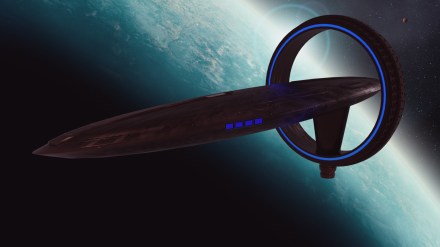
Selek, his chosen guard, and the starship crew boarded a Suurok-class ship in orbit for a final briefing. It would take them to the edge of the star system, where they would be transferred to a smaller D’Vahl type, the Kir’Shara, which was a survey vessel as opposed to a fighting ship. The Vulcan High Command had determined speed was a better option than fighting prowess.

The constant hum of the engines was like a white noise that helped him put the emotional part of his brain to sleep. It wasn’t only the stress of being separated from T’Nedara but the life he was trying to build for himself on Vulcan. He kept telling himself that the mission was a logical step towards that goal. There was some comfort in that, and even some reluctant excitement for what awaited him.

The mission was planned to be simple. Travel covertly to Romulus and use the scant information they had to find and recover their sacred texts. The transmission indicated that the texts may be hidden off-world, but Selek was hoping to rescue those who had sent it, if possible.

He was fascinated with the idea of the Stones, not only about the secrets they might reveal about Surak’s writings but how they had remained hidden until now. T’Nedara has mentioned that Surak’s writings on Logic felt one-sided, as if something was missing. It seemed to contradict the whole philosophy of the IDIC[17] and the dual nature of Vulcan spiritual belief.

What would Surak determine be the absolute opposite of Logic, but at the same time, powerful enough to be its equal?

He was so deep in thought that he didn’t notice one of his soldiers approach him until she was almost under his nose.

“Sir, there’s an issue with the data storage.”

Selek turned towards the line of computers that lined the bridge and saw a few crew members fussing over a console. A circle of yellow light was turning next to the screen.

“What issue?” But he didn’t wait for her to answer and was next to the computer in a few strides. The Captain was leaning over the technician, who was explaining the issue while simultaneously trying to handle it.

“Someone is copying our data storage,” he said, “the information about the ship, crew, and mission is…”

“Captain,” the comms officer interrupted the technician from the other side of the bridge. “Incoming Klingon ship.”

“At least we know where our data has gone,” Captain T’Arev stood at her full height, walked over to her chair, and pressed a button on the armrest. Green[18] lights flashed on the panels about their heads.

            T’Arev pressed another button.

            “Engineering,” She said crisply. “We have a Klingon ship within range. Are you prepared to say hello?”[19]

            There was no response. The Captain furrowed her brow, and opened her mouth again, but her voice faded away.

            Selek barely had time to catch his breath before the flashing lights and chattering voices lost focus and disappeared. He saw a bright light and felt a chilling cold. The stars winked out, and he was swallowed by the darkness.

            T’Nedara had a forgetful sleep after the katra’s vision, without dreams or noise, and when her eyes flickered open the yellow sun of late morning was stretching across her bedroom floor. She sat up and hugged her knees to her chest, fighting off a sudden chill and wondering if it was too late to prepare some gespar, as protocol commands a guest.

            T’Pol was waiting in the kitchen. She was standing over the countertop, which also included two cups and a steaming kettle. T’Nedara bowed her head.

            “Rfik-kosu,” she said quietly, “Forgive me, I have not prepared breakfast in a timely manner.”

            “You may call me T’Pol,” the sub-Commander replied. She turned and opened the cooling tray. A few slices of the bulbous fruit had already been chilled, and they were placed on the counter between the two of them.

T’Nedara stood motionless as T’Pol poured the tea. It was customary to use replicators, but this retained some classic tradition for their first meal together. It was safe to say it was the first of many rituals they would share. 

  “I would also request that you specify why you refer to me with a title reserved for a female ancestor.” T’Pol said, as they nibbled at the tart, fig-like fruit. “We share a family bond, but not one of blood.”

“If I can use your tablet to access the Infirmary records, I believe I can explain. They should have been saved on an external server if the computers were damaged.”

It was only a matter of a passkey and biometric scan. T’Nedara was hopeful this meant the computers on the lower floors were still intact.

The record appeared, and she stepped back to let T’Pol have a look. 

            At first, the sub-Commander said nothing, but her eyes widened. T’Nedara wondered how she would react. Perhaps they weren’t even sure if Selek could have children.

            “Your use of the title is now apparent,” she said, her tone revealing nothing about her feelings on the news she was going to be a grandmother. “However, I also understand why the Cult of Maripol attacked the temple, and more specifically, why you were targeted.”

            T’Pol nodded towards the tablet.

            This was the complete record this time, the one that she and T’Krella had left to complete when they went to bed.

            Maripol was one of the lesser gods of the Vulcan pantheon, and she was a malevolent creature that demanded blood sacrifice. Her most sacred offering was the hearts of twins because of their auspicious connotation. Multiple births are not as common among Vulcans as they are in humans.

T’Nedara hid her joy and excitement behind a calm facade of fear and guilt.

            “They must have been watching the system,” she said quietly. “They would have had access to anyone we had treated.”

            There was another light flashing on the screen. A soft blue square, slowly glowing bright and dim again in the corner.

            “I have a private message,” T’Nedara tried to hide her excitement. She knew it was from Selek. Heedless of T’Pol’s eyes looking over her shoulder, she opened it in a separate screen that projected an image from the original.

            “His ship has left orbit,” She said, reading his heartfelt words and remembering the heat of the kitchen.

            “The sooner the departure, the sooner the return,” T’Pol quietly recited an old Vulcan saying as she reviewed a larger, brighter screen. It was the plans of the monastery with the damaged areas marked and annotated.

            “It seems most of the structural damage has been confined to the Upper Spire,” T’Pol said, as she examined the schematics. “It seems the integrity of the base and lower floors are sound.”

            T’Nedara had already turned to a third screen that led to a private server the residents of the temple would access for messages, references, and basic information. The program was usually a hive of activity, reflecting the busy schedules of various floors and an inventory of supplies for each. Now it was strangely quiet, but some of her colleagues had left a sentence or two on an electronic bulletin board to confirm their survival. A few asked their friends and fellow monks to answer in kind. Many were still missing.

            “You are the Mother Superior now,” T’Pol said quietly. “Overseeing the reconstruction of the temple and rallying the survivors is your responsibility.”

            T’Nedara was grateful to have a distraction from her other troubles. She was happy to see the quick responses from her initial messages. Eventually the conversation was distilled into three important issues; the new design and rebuilding of the temple, the investigation into how the Cult of Maripol had infiltrated their systems, and the additional security to prevent such attacks in the future.

            “The new Head of Security had some thoughts about this,” one of the guards mentioned. “The files he started are available on the main computer.”

            Selek had mentioned he thought the temple was too old-fashioned when it came to safety. He had made some future plans and discussed them with his immediate subordinates. The ones that had not gone into space formed a separate group and began making their plans to implement changes.

            T’Nedara decided to revisit the site in the afternoon. T’Pol asked to help with the security measures and also offered to contact Koss to help with the new temple plans.

Other pressing issues, like interring the dead and clearing the rubble, had to be seen to before any other ideas could be implemented. T’Nedara asked that everyone available come to the site to help with identification so the rites could be performed and the bodies interred.

It had been a few hours since T’Nedara had first risen from Selek’s bed, seemed that everyone had their orders and plans for the day. She made a few personal notes regarding the injured that were unable to return, and would make a list and start making personal visits to the various hospitals and clinics.

T’Pol had her own paperwork to organize. Koss had sent her a letter along with some sketches and schematics of the temple. The base was sound, and the foundations were intact, It was the upper floors that had seen most of the damage, which he admitted was strange. It was illogical for the cult to have destroyed a part of the temple that was barely in use.

T’Pol wrote a letter in return, saying that she and the future Mother Superior would be returning to the temple shortly. She didn’t reveal any other details, and wasn’t sure when or how to bring up the cult’s real motive. The investigation would continue, and it was likely T’Nedara would divulge the information to the proper authorities at the appointed time.

Both of them seemed to have their afternoon schedules organized.

            “We’ll have a light meal, then make our way to the site,” T’Pol suggested, turning to a replicator. “Do you like plomeek soup?”

            “I do indeed,” T’Nedara replied, “I have a story to tell you about that, actually.”

            She talked about meeting Selek in the kitchen and the grilled plomeek root.

            “He’s clever,” T’Pol said, trying not to sound too smug. “Don’t let his feigned detachment trick you into thinking he’s uncurious.”

            “It feels like a human trait,” she said gently. “To pretend emotional stoicism through silence. Um…what is that you’re putting in your tea?”

            “It’s a fruit from earth.” T’Pol had removed another tray from the replicator with two cups and something that was bright yellow. It had a sharp but pleasant odor and seemed to bring its own light into the room.

“It’s called a lemon.”

            “A fruit from earth? But that means…doesn’t it have sugar[20] in it?”

            “Very little, but enough to take the edge off, as they say. It’s something I learned while serving on the Enterprise. What Captain Archer didn’t know never hurt him.”

            “What was the most difficult part of dealing with humans?”

            “The smell,” T’Pol said, without hesitation. “I had to have candles burning in my room almost all the time.”

            “I hear they’re emotive but withdrawn.” T’Nedara said. “It seems contradictory.”

“They speak in metaphors and symbols and never mean what they say,” T’Pol raised her voice and closed her eyes for a moment as if in pain. “They have a hundred thousand languages on that planet, and they still can’t communicate.”

 “It would have driven me to the brink of madness.” T’Nedara lifted her own tea to her lips, impressed by T’Pol’s outburst.

            “The humans have a saying,” T’Pol said gravely, as she dropped the lemon slice into her cup. “In space, no one can hear you scream.”

The New Temple

The shuttlecraft rose from the covert landing pad in the open green space behind the house. T’Nedara was busy organizing the next few hours on her tablet, but she didn’t fail to notice the second shuttlecraft that had quietly come up on their port side. It was dark red and was clearly marked with the brand of the planet’s highest authority.

            “The Vulcan High Command has provided me with a private security detail,” T’Pol explained, without turning away from the controls. “They are aware of your presence, and you are also under their protection.”

            “I’m grateful, T’Pol,” It had taken all morning, but T’Nedara had grown accustomed to calling Selek’s mother by her first name instead of using a formal title.

            “It’s not a gift or a favor. My commanding officers have a vested interest in seeing the temple restored, or at least the records and research preserved.” She continued, “I’m sure they’ll send a representative once the integrity of the site has been determined.”

            An authority on architecture and restoration was already there. Koss was waiting for them on the landing platform.

Koss worked independently, and had taken it upon himself to check the site out of his own personal interest. He had been in contact with T’Pol, who had arranged his access on behalf of the Vulcan High Command. With the help of his younger son Savvik, who was following in his footsteps, he had already taken detailed survey notes and was ready to present them to the Mother Superior.

The shuttlecraft landing was flawless, and Koss took note of a second craft just behind it, hovering a few meters above them, before it drifted towards the stricken temple at surveillance speed. There were other ships and drones doing the same, taking pictures and measurements throughout the site. Cameras and lasers flashed over the cracked rocks and torn masonry.

T’Pol quickly stepped through the door and down the stairs. T’Nedara took a moment to straighten her robes. It occurred to her that she was without her veil or bracers, but she expected most of her colleagues would also be missing their formal wear and now was not to time to fuss over such details. From that moment on, she focused on her work.

“T’Nedara,” Koss addressed her immediately, bowing his head. “I am honored to meet you, despite the dire circumstances. My son and I are at your service.”

The young man at his side also bowed his head, but remained silent.

“Koss has assembled a recovery team.” T’Pol began a debriefing as they walked towards the main entrance, which was undamaged. “We’ve converted the main floor into a meeting hall for now.”

The construction workers and technicians wandering through the main grounds were strangers to T’Nedara. They were busy with their work and mostly ignored them unless Koss spoke to them directly.  

The three of them reached the main floor of the temple and T’Nedara finally recognized the faces of her colleagues and friends. They were in a mix of casual robes and civilian clothing; a motely group compared to their usual perfect order. This was usually a place of deep and abiding quiet, so peaceful that you could hear the incense burning. Now it was cluttered with wires, tables, and viewing screens of various sizes.

     One of her colleagues, a monk named Muran, rushed over to her with little pretense of Vulcan stoicism.

“T’Nedara,” his voice was steady but his eyes were red and puffy. He took her hands in his, as much for his comfort as hers. “We found her, the Mother Superior…”

“I know, Muran, I was there. I am the keeper of her katra. She will be interred in the catacombs as was her will. We will honor her life and continue to honor Surak according to her will.”

Muran’s eyes fell. He took a step back and withdrew his hands to make the sacred symbol of the temple before his bowed forehead.

“Mother Superior,” he said, and it was the first time she had been addressed formally with the title. A few other survivors had gathered and made the same gesture.

Mother Superior,” their voices formed a chorus. For a moment the sacred chant seemed to wipe clean the profane. Koss and T’Pol stood back quietly, watching and listening to the sacred circle in fascination.

“Until the temple is rebuild and consecrated, I am only the acting Mother Superior.” She spoke quietly but her voice carried. “The ancient laws must be obeyed and the ancient rites satisfied. It will all be done, in the name of T’Ulla and the word of Surak.

“Our first order of business is to inter the katra of the Mother Superior, according to her will.”

The circle nodded in agreement. The worst damage was upstairs, leaving the catacombs beneath the kitchens intact and untouched. This wasn’t just a way of signifying T’Nedara’s ascension as Mother Superior, but also to clear her mind of another’s katra.

It was important that T’Ulla could be put to rest. The repose of her soul would be a symbolic gesture that would unite and rally the survivors.

It would also be a useful way to clean up the ruins and remains, starting from the ground up. The ritual was based on a traditional funeral procession that would begin on the outdoor space designated for the cremation pyres, then continue to the temple space on the main floor, and then finally to follow the long spiral staircase down into the catacombs.

T’Nedara instructed her fellow monks, along with several of the soldiers, to help clean and consecrate the main floor. She then approached Koss and T’Pol to explain, who were standing nearby.

They were looking with some concern at a small tablet T’Pol was holding in her hand. Their eyes rolled heavily toward T’Nedara as she approached, and she felt the weight of their gaze like a heavy rock sliding down the mountain.

“We have received word from the Vulcan High Command,” Koss said, and his voice sounded heavy. He looked at T’Pol, almost as if you ask for help, but her eyes were fixed on T’Nedara.

The monks and soldiers that has been left behind in the temple and survived it’s near destruction pretended not to listen as they cleared the dust and rubble off the floor, propped up the idols, and relit the candles and incense.

“The Kir’Shara has been destroyed,” T’Pol’s spoke with a flat, dull voice that sounded bored. “There is no sign of the crew. A ship has been dispatched to investigate the crash site.”

The last few digital words of Selek, which she had read from the doomed ship only hours ago, flashed across her mind. Had she read a message from the beyond? And did she have the strength to reach into space and save his katra as well?

The cold of the stone floor seemed to open up and swallow her. She felt the warmth of a hand on her shoulder, and a blurry light came back to her eyes.

T’Pol guided the Mother Superior to a sheltered alcove with a wooden bench and sat down next to her.

“I’ll get busy clearing the stairway,” Koss cleared his throat before he spoke and made his way towards the lower dais. The other monks looked at him with raised eyebrows.

“The Mother Superior isn’t…weeping, is she?” One dared to say it out loud.

“Certainly not,” Koss snapped back. “I’m shocked at the presumption of a mere novice. The air here is warm. Even a hardened Vulcan will perspire in these conditions. Get to work!”

He chased them down to the lower stairs, barking orders.

T’Nedara and T’Pol sat close together in the quiet shade of the alcove.

“Only the ship’s debris has been found,” T’Pol said, her voice not so bored anymore, but now hesitant, as if she didn’t know what to say. It wasn’t something that happened to T’Pol often.

     “The crew is still missing.”

T’Nedara said nothing. She could only bow her head to hide her tears.

“There have been many times when we thought colleagues were lost or dead,” She continued. “But they were caught up in a mystery that we had yet to discover and understand.”

T’Nedara raised her head. Her eyes and cheeks were shining but her face was hopeful.

Ashayam ko-fu,”[21] T’Pol continued, “Please don’t despair. Space is a strange place and there is much we don’t understand. Selek might still return to us. But now, we have a temple to rebuild, and you have a ritual to lead.”

            The Vulcan method of burial under normal circumstances is cremation. A deceased individual would have their own pyre, and their katra and ashes would be interred in a deep, natural cave that also held the last resting places of their peers, colleagues, family, and ancestors. The temple housed some of the oldest catacombs on the planet, with katra stones that were thousands of years old, much older than the word of Surak, even as old as legends of the ancient gods.

            Given the circumstances, T’Nedara had to make some adjustments to each stage of the burial rites and the cremation ritual.

Some of the finer details could remain the same. The treated candles[22] should line the stairs one quarter cusac[23] apart. The wicks are treated with a flammable liquid to make them easier to light with basic psionic powers. It’s a fundamental ability that all Tinsha monks study and perfect, but only a psionic master can start a fire from only a dry wick.   

            There was an advantage to the reconstruction and the burials in that she was distracted from her grief. She took notes between directing her fellow monks regarding her preparations and speaking with the soldiers about security and repairs. The noise of hammers, drills, and saws filled the air but couldn’t permeate the peaceful space in her head. She was not alone. The katra of T’Ulla stayed close to her, more a light than a shadow, and guided her hand.

            The upper launchpad, where T’Nedara had stood and watched Selek’s shuttlecraft lift into space, had been cleared. This would be the site of the immolation pyres, where the bodies of the deceased would be reduced to ash, then mixed with water and the crushed leaves of a plant in the kitchen. It turned the mix into a dark green ink. The new Mother Superior and her fellow monks would use it to paint their bodies with the words of the Ritual of the Light.

It was then the chant would begin. It would follow them as they marched down the stairs and into the depths of the temple, deep into the catacombs, where the memorial stones were so thick and old they were like cobblestones on a long, wide street. Then they would don the simple mourning robes, simple grey with no adornments, and inter the souls of their fallen friends.

            The clean-up and construction was halted for the ritual. Koss and T’Pol instructed their workers to observe, stand away, and keep their silence.

            The sun fell, the flames rose, and the ritual began.

The Ritual Of Light That Opens The Darkened Way[3] 

These are the words of Surak.

Nothing is born, nothing dies,

nothing is pure, nothing is stained,

nothing increases and nothing decreases.

The procession wound it’s way down into the warm darkness of subterranean Vulcan. The candles sputtered to life as the Mother Superior stepped past them, her steps were slow and deliberate.

These are the words of Surak.

There is no feeling, no thought, no will, no consciousness.

There are no eyes, no ears, no nose, no tongue, no body, no mind.

There is nothing seen, nor heard, nor smelled, nor tasted, nor touched, nor imagined.

T’Nedara could feel herself sinking into the earth and rock, but it was a gentle sensation, as if she was returning home, and home was a safe place.

These are the words of Surak.

There is no old age and death, and no end to old age and death.

There is no suffering, no cause of suffering, no end to suffering, no path to follow.

There is no attainment of wisdom, and no wisdom to attain.

The procession came to its final destination, the resting place of T’Ulla, the former Mother Superior.

These are the words of Surak.

This is truth that cannot be doubted.

Gone, gone, gone over, gone fully over.

And then awakened!

These are the words of Surak.[24]

T’Nedara reached forward and touched the stone that would hold the katra of the former Mother Superior for all eternity.

            Farewell, mentor and mother, she said in her mind, I am blessed by your guidance. Rest well, and know your memory lives on.

There was a reply.

Your gratitude is my reward. I thank you for a sublime and profound ritual. Before I depart and take my rest, I will say one thing more.

I speak his name, but his voice does not answer.

Take comfort. He is not among us.

Live long, and prosper.

T’Nedara reached out with her psionic powers and lit one extra candle, a lone one placed by the broken kitchen door.

What Really Happened to Tripp Tucker

It took a few weeks for the temple to be repaired. Until the new living spaces were prepared, including the Mother Superior’s renovated apartments, T’Nedara stayed with T’Pol in Shi’Kahr.  

Other than preparing for the site’s reconsecration, which included composing new rituals, restocking the temple supplies and reorganizing the altered floor plan, she spent most of her time learning English and trading stories of Selek with T’Pol.

“Your interest in Terran vernacular is timely,” the sub-Commander remarked. “Were you inspired by Selek?”

“I was,” She replied. “He showed me a mover…”

“I believe it’s called a movie.”

“Oh. Yes, and it was in English. With Vulcan subtitles for my benefit, naturally. It was interesting to me how the setting was a character of its own. New York City is an important place in Terran history, isn’t it?”

“It is immensely important. The greatest human city of the 20th century. What was the movie called?”

“This eludes me for the moment,” T’Nedara furrowed her brow as she spoke. “Something onomatopoeic and only tangentially related to the subject matter. I asked for a story about human mythology and was surprised it was set in a modern era.”

“Human are as creative as they are superstitious.” T’Pol even smiled a bit. “I always enjoyed horror movies.”

“I’m not sure about the whole idea of making a person scared on purpose,” T’Nedara tried not to sound too critical. “I was surprised to find out such a genre existed.”

“The human mind likes opposites, the same way that Vulcans do. They like their drama and horror as much as their romance and comedy. But this was not horror, obviously.”

“Oh, no, it was a romance. A sea creature fell in love with a human. It was also funny, though. I must admit, a few lines brought my laughter to the surface.”

“I think I know the one you mean. It’s a retelling of an old story, ‘The Little Mermaid’ but with a happier ending.”

“It’s still a bittersweet one. I must extend some empathy to the brother of the protagonist. He would have been incarcerated for the rest of his life.”

The conversation moved to the concept of literary adaptation, another persistent human obsession.

“I saw a book in Selek’s room,” T’Nedara said, “with a notorious history in this regard. I’ve seen excerpts in Vulcan, but I would very much like to read the original.”

“A Terran vision of a desert planet, created in the years before first contact, is indeed fascinating.” T’Pol replied. “There was a time when humans had reason to believe they were alone in the universe and did not yet understand warp technology.”

“The chant they use, the mantra against fear – it’s something Surak would have composed and taught. I can’t ignore such an obvious parallel.” T’Nedara couldn’t hide her interest in the book. “And the spice! Of course, our redspice doesn’t come from giant worms and isn’t a hallucinogen. But I can see the ancient Vulcan ways, in the way they preserved water and fought with ruthless, amoral energy.”

“Humans and Vulcans might not be so different when it comes to their tumultuous history.” T’Pol paused, and seemed to compose herself before continuing. “The discovery of the warp drive and First Contact brought them out of a difficult time. But they entered another one just as quickly.

“We protected them for as long as we could. They were adventurous and brave, but foolish. I watched the crew of the Enterprise learn the reality of life in space. I watched their optimism fade, sometimes even twist and change into bitterness.”

“Is that what happened to Tripp?” T’Nedara asked.

T’Pol was surprised by the directness of the question. Other Vulcans were often reluctant to ask about her human crewmates, especially Tripp.       

“The official records claim he died on the Enterprise,” T’Pol began, “but you, of all people, deserve to know the truth.”

That was how T’Nedara became the first person to hear the whole story of what really happened to Charles Tucker III, the Chief Engineer of the Enterprise.

“According to all of the official accounts, Charles Tucker the III died in an accident on the Enterprise in the year 2161. There were two other important events that happened in the same year; the formation of the United Federation of Planets and the formation of an organization called Section 31 in response to that.

“Section 31” gets its name from Article 14, Section 31 if the Starfleet Charter. It states that any extraordinary measures – even those that include murder, theft, and sabotage – could be undertaken if the Federation or United Earth was under an existential threat.

When Tripp first left Earth to explore space, he was hopeful, optimistic, and dedicated to his friend Jonathan Archer and his dream. Perhaps he was too optimistic. Maybe we can credit him for giving everyone in the galaxy the impression that humans were friendly, enthusiastic, and painfully naive.

The Xindi attack changed him. His sister, Elizabeth, was one of millions that were killed.  The human capacity for joy has its mirror image in their rage. Tripp’s anger went beyond a simple longing for revenge, and his energy and knowledge turned away from flirting, exploring, and making friends.

The accident did happen, and the circumstances that were reported regarding the Andorian General Shran and Captain Archer are factual. However, Tripp didn’t die as a result. His body disappeared from the hospital and the morgue. When they gave me his personal effects, I asked who had identified him, and I was told his parents had claimed his body based on biometric information sent from Earth.

I was charged with delivering his belongings to his family. When I met them, they said that they had been told his body had been damaged by radiation, and could not be safely returned. He had been safely disposed of in space after being identified by Jonathan Archer. I kept my silence about the discrepancies in each story, including the fact that Tripp’s burns, although serious, were not due to radiation.

I returned to Vulcan. After a few months of silence, mysterious notes started to appear in my personal logs. Only a masterful engineer and very clever programmer could get through those Vulcan security protocols. I traded a few notes with an anonymous user who eventually revealed himself as Tripp, not by using his name, but with references to deeply personal events shared by only the two of us.

I still didn’t believe it was him until he actually appeared in my house. Literally, using a transporter, technology that’s barely functional outside of the Vulcan High Command.

You may have guessed that I was pleased to see him, and wasn’t bothered with a lot of questions at first. He still retains the scars of the accident, and refused to tell me everything at the time, but confirmed that his death was a fabricated event to extract him from the Enterprise. His determination to seek out and destroy anything even remotely connected with the Xindi put him on the radar as a valuable ally for those who would pursue the path of the extremist.

It’s not clear when it started, or if he was one of the founding members or just a recruit, but he didn’t call it Section 31 at the time. Not everyone liked the idea of a galactic federation based on universal justice. It’s logical to include espionage as part of any government system, but it’s crucial to keep it clandestine, and Tripp was risking his secrets to come out of hiding to be with me.

The pregnancy was a surprise, as you may have guessed. Elizabeth, Selek’s older sister, was created through artificial means and it was thought that a Terran-Vulcan hybrid was an impossibility. We considered termination, not only for out fear of exposing Tripp but due to the possibility of physical damage to myself. However, my condition advanced normally, following the Vulcan gestation period, and Koss agreed to step in and fill the role of ‘father’ on all of the relevant government forms.

Tripp Tucker remains a member of the secretive organization that is now known throughout the universe as Section 31, a rogue splinter group associated with terrorism, espionage, and extortion. Tripp hasn’t always approved of their methods, which have only become more extreme, and these days he is more a hostage than an equal member. They need his engineering knowledge, and they threaten him, and his loved ones, to get it.

I was never worried about dealing with them. You have seen me handle a plasma rifle. But I did have some maternal concern for my son, who would be in danger if his true ancestry were discovered, and by keeping this secret I have kept him safe from his father’s colleagues.”

“The secret may have been discovered by the cult,” T’Nedara said. “They have my biometrics.”

“But not the skill to read them, not the finer details. We will find and destroy any information they have. While you rebuild and study, I will conduct a thorough investigation.”

She paused, and seemed to focus on a place far in the distance.

“They will be found. And punished.”

“Please consider all of the resources of the Temple at your disposal,” T’Nedara had to breath deeply to hide her visceral emotional reaction. But she couldn’t hide the raised volume of her voice or the green flush in her cheeks.

They conversed no more that night, but there was an unspoken understanding between them regarding the fate of the cult.

T’Pol quietly utilized some questionable search methods only available to a sub-Commander, taking liberties with the rules that ensured the safety and privacy of Vulcan civilians.

T’Nedara, meanwhile, had successfully discovered the ancient texts of the Kolinahru, and studied the forbidden psionic powers in secret.

Denied love, they would indulge their rage instead. It was a bold but risky path, especially for Vulcans.


[1] A plant grown on Vulcan used to make a body paint very similar to henna.

2 Arranged marriage in childhood. Vulcans are generally seven years old when betrothed to a future mate.

3 This is more like kissing than just “holding hands.” The fingers and hands are erogenous zones for Vulcans, so this is a gesture for lovers alone. It’s not something done with friends or acquaintances.

[4] A six-legged herd animal native to Vulcan.

[5] Vulcans have a variety of sleeping robes and gowns that often take the place of blankets, sheets, or other bed linens that humans would use.

[6] An ancient historical figure known as the Matron of Vulcan Philosophy.

[7] The Vulcan term for mother

[8] Star Trek: Enterprise, “The Forge”, “Awakening”, “Kir’Shara.”

[9] The Vulcans who rejected the teachings of Surak and left their home planet to evolve into Romulans.

[10] The main ingredient in V’Shal dinner, a meal traditionally served by a Vulcan male to his intended in-laws.

[11] Koss’ second wife.

[12] Star Trek: Enterprise, S4E21, “Terra Prime.”

[13] Known as “shon-ha-lock” in the Vulcan tongue, what humans might call “love at first sight.”
[14] The nickname Vulcans gave to the inexpensive living quarters that were produced in large numbers and often used to house the sick, indigent, or other disenfranchised groups like refugees.

[15] “Life friend”, a term used for close friends and siblings.

[16] A Vulcan curse similar to “damn” or “hell.”

[17] Infinite Diversity, Infinite Combinations

[18] Green is the color Vulcans use for alarms and warning lights.

[19] A reference to an event that marked First Contact between Klingons and Vulcans near the planet H’atoria in 2016.

[20] Sugar acts as an inebriate to Vulcans, like alcohol does to humans.

[21] Beloved daughter.

[23] A unit of measurement equal to a meter.

[24] Taken from and inspired by the Heart Sutra.


 Other useful links..

https://memory-beta.fandom.com/wiki/Vulcan_Institute_of_Defensive_Arts

https://memory-beta.fandom.com/wiki/Kolinahru_Monastery

https://memory-beta.fandom.com/wiki/Kolinahru

https://memory-beta.fandom.com/wiki/Llangon_Mountains

 [3]https://webspace.ship.edu/cgboer/heartsutra.html